Big Red Flashback: Cardinals Dismiss Wally Lemm

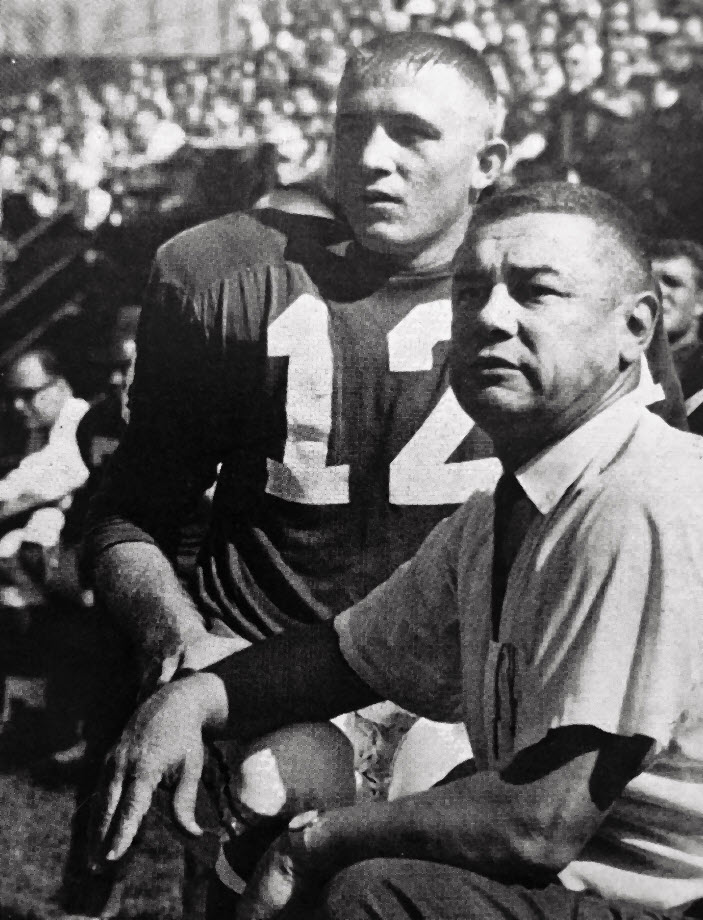
After a disappointing 5-9 record and citing the need for him to reside in St. Louis year-round, the Cardinals dismissed head coach Wally Lemm on January 10, 1966.

The Chicago native spent his offseason in Lake Bluff, IL, and declined to move to St. Louis until his children graduated from high school. His son Mike was in college, but his daughter Debbie was only in her junior year.

Wally Lemm coached the Cardinals from 1962-1965.

“We knew when we hired him that Wally wanted to be head coach on a six-month basis and that was fine,” club president Stormy Bidwill told the St. Louis Post Dispatch after Lemm’s dismissal. “But we felt more and more strongly that we wanted a head coach who would be with us all the time.”

“When the issue came up again, there was no compromise available, and by mutual consent, he is leaving the Cardinals.”

“We’re sorry that Wally is leaving because he did a good job with the Cardinals in the past seasons. Wally’s record speaks for itself and he had a good record.”

Lemm didn’t feel it was necessary to live in St. Louis during the offseason.

“I know the job can be done without being present in the offseason,” Lemm said. “We never went into training camp unprepared.”

Continue reading

The 10 Greatest Big Red Games From the 1960s

With NFL training camp upon us let’s take a look at some of the greatest games in Big Red history. Below are my top 10 games from the 1960s. Agree? Disagree? Leave your thoughts in the comment section.

September 23, 1960: St. Louis Cardinals 43, Los Angeles Rams 21

Six months after relocating from Chicago the Big Red played one of their greatest games of the decade when they beat the Los Angeles Rams 43-21 at the L.A. Coliseum. Box Score. John David Crow scored the first touchdown in St. Louis Cardinals history, John Roach passed for four touchdowns, three of them to Sonny Randle, and the Cards defense forced six Rams turnovers, a safety, and had 8 QB sacks in the victory.

“Randle had a phenomenal night,” head coach Pop Ivy said after the game. “It was nice to see Crow going again, too. That was a remarkable run on that screen pass.”

Continue reading

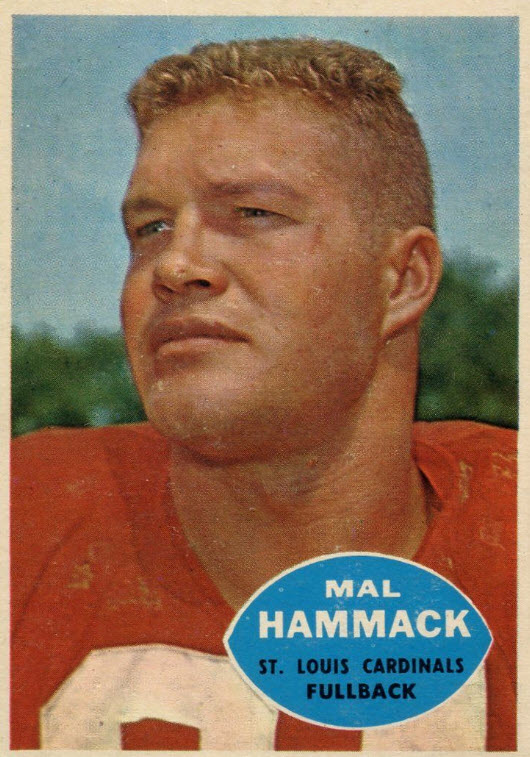
Forgotten Big Red Stars: Mal Hammack

Many remember hard-hitting Big Red special teamers like “Dr. Doom” John Barefield and Ron Wolfley, but a long forgotten “wedge-buster” from the 1960s was Mal Hammack.

Malcolm “Mal” Hammack started his career with the Chicago Cardinals in 1955. The Roscoe, Texas native played college ball at the University of Florida where he was second team all-SEC fullback. Chicago drafted him in the third round and wanted him to play linebacker, however, his weight of 200 pounds was on the light side, even in 1955.

Hammack was used sparingly at linebacker his rookie season and was soon moved to fullback where he would play most of his career. But he earned his mark on special teams. Hammack was a fierce competitor, loved contact, and was known for his body-jolting blocking and tackling. He was the lead Kamikaze and captain of the special teams.

“I like to go down on punts with a chance to kill the ball close in or maybe jolt the ball out of a receiver’s hands,” Hammack told Bob Broeg of the St. Louis Post Dispatch in a 1966 interview, “but I believe the most satisfaction is in peeling back to help block for a punt return, hopeful that it might go all the way. The most satisfaction, that is, next to winning.”

Continue reading

SI VAULT: TWO FLAGS FOR THE CARDINALS?

(Excerpt from the November 09, 1964 Edition of Sports Illustrated)

Written by Edwin Shrake

PENNANTS HAVE NOT RECENTLY FLOWN OVER THE CITY OF ST. LOUIS. THIS YEAR THE BASEBALL CARDINALS BROUGHT ONE HOME, AND THE FOOTBALL CARDINALS MAY BRING ANOTHER FROM THE SCRAMBLE OF THE NFL EASTERN DIVISION.

John David Crow

In St. Louis last week a bunch of guys with sledgehammers were knocking down an old burlesque house to clear ground for a new stadium, which means that by the spring of 1966 night baseball and Sunday afternoon football will have replaced sex in at least one area of the leafy and pleasant town on the banks of the Mississippi River. For the citizens of St. Louis, who sat 18 years in the gloom of Busch Stadium waiting for their baseball Cardinals to win another World Series, the new stadium is a merit badge for patience. A further reward may be granted to St. Louis fans before the first graffito is scratched into the concrete of the new stadium. The football Cardinals leaped off to a flourishing 3-0-1 record in the NFL’s Eastern Division.

Continue reading

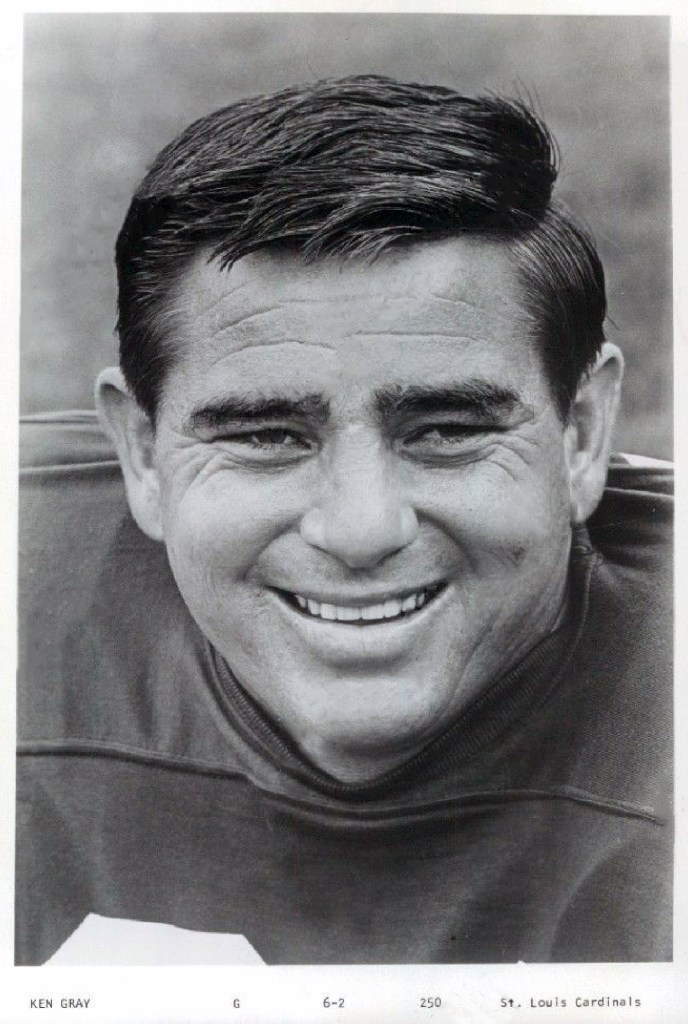
Forgotten Big Red Stars: Ken Gray

Posted by Bob Underwood

Ken Gray was part of the greatest draft class in Green Bay Packers history. The Texas native was taken in the 6th round of the 1958 draft along with future Hall of Famers Jim Taylor, Ray Nitschke, and Jerry Kramer. The Packers also nabbed future All-Pro linebacker Dan Currie.

Ken Gray was a 6x Pro Bowl guard with the Cardinals from 1958-1969.

Gray and Kramer battled for a roster spot throughout training camp. A coach actually told Kramer that he would probably be traded because they had too many guards. But it ended up being Gray who was among the last cuts just before the start of the season. After his release, Packer head coach Ray “Scooter” McLean told Gray that he “would play somewhere in this league.”

“My heart went to my feet,” Gray said in a 2015 story in the Picayune, but what could I say? Those experiences make you a better person and better player.”

Based on the talent of both Kramer and Gray, the Packers should have kept both players as they would have made quite a tandem at guard over the next several years. The Packers went 1-10-1 in 1958 and McLean was fired and replaced with Vince Lombardi.

Meanwhile, Gray signed with the Chicago Cardinals and played defense his rookie season. He was moved back to guard in 1959, gained 30 pounds and was named to his first Pro Bowl two years later.

Continue reading

Big Red Flashback 1962: Cards Hire Wally Lemm

(Editor’s Note: This is a short excerpt from Robert L. Burnes book Big Red: Story of the Football Cardinals, published in 1975 )

To present a picture of Wally Lemm, the best approach, perhaps, is to indicate what he was not as a coach. He was not, for instance, the bristling, driving type of coach Vince Lombardi was. Nor was he the perfectionist that Paul Brown always has been. Nor the fundamentalist that Tom Landry has been. Nor was he a devotee of the George Allen system, which dictates that twenty hours of every working day, seven days a week, must be given over to making the football team a winner.

Wally Lemm with Big Red QB Charley Johnson in 1962

If he resembled any man in approach to the job, if not in flamboyancy, it was probably Jim Conzelman. Jim Conzelman always said, “Football is supposed to be fun,” and Lemm echoed the sentiment. Football was a major part of Jim Conzelman’s life, yet he walked away from the game several times and found other pursuits equally rewarding. So did Wally Lemm.

Continue reading

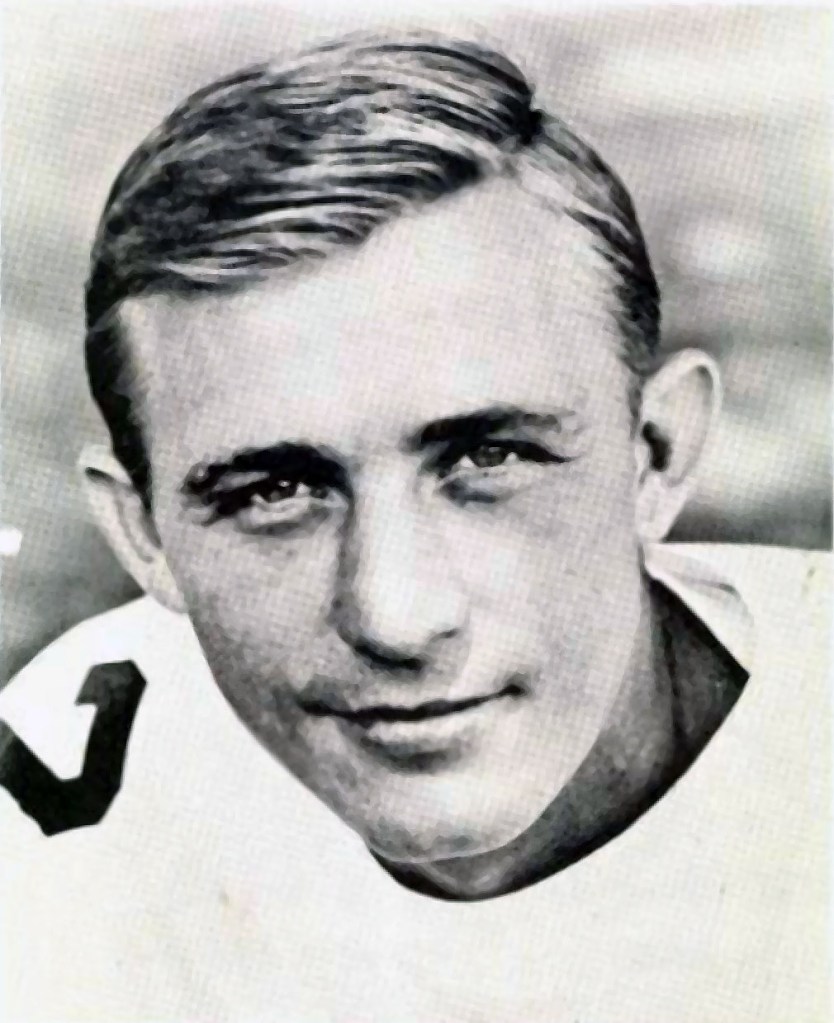
Big Red Legends: Charley Trippi

The oldest living member in the Pro Football Hall of Fame rose from his chair, eyed his target squarely and moved in for the play. With his wife, Peggy, cheering him on, he huffed, and he puffed, and he blew out every one of the 99 candles on his birthday cake.

His health may be betraying him—his hearing is shot, his mobility is compromised, and he fell and broke his shoulder while walking out to the mail box a few months ago—but Charley Trippi hasn’t lost the singular trait that defined his magnificent football career, where he was a multi-dimensional player at the University of Georgia and in the NFL.

“I’ve never met a man more determined than my grandpa,” says Clint Watson. “If you go back and look at all the pictures of him in action, you’ll see a similarity. You’ll see the face that he’s making. He’s gritting his teeth and straining with every ounce of energy and determination that he has. When you see those pictures, you’re like, ‘That’s Pa-Pa.’ He has a determination about him that a lot of people just don’t have.”

Trippi lives in Athens, Ga., not far from the college stadium where he starred in the mid-1940s. You used to be able to drive by his house and see Charley out in his yard, raking leaves. But he pretty much stays inside any more.

Born on December 14, 1921 in Pittston, Pa., Trippi was the son of a Sicilian immigrant coal miner. His mother died when Trippi was young. Trippi played football at Pittston High School, but he felt he needed to add some weight before playing in college.

Continue reading

The Rise of Charley Johnson

(Editor’s note: This story is a reprint from the January 1966 issue of Sport Magazine and was written by John Devaney.)

In sports, some success stories begin with a dream. Here is how one dream of playing professional football came true — at almost impossible odds.

By JOHN DEVANEY

The quarterback was sitting bare-chested, on the edge of the rubbing table. He was holding a white towel to his face, and a large crimson stain was slowly spreading over the towel because blood was pouring from a gash in his chin. The quarterback didn’t seem to notice the blood. He was staring at the floor with the rapt concentration of someone watching scenes from his life flash, one by one, on a movie screen.

This was Charley Johnson, St. Louis Cardinal quarterback, in the visitor’s clubhouse at Yankee Stadium one afternoon late this October. Minutes before he had run off the field, plunging almost blindly through the swirling crowd, after New York had beaten St. Louis 14-10. Twice in the game’s closing minutes Johnson had brought the Cardinals inside the Giant 25, and twice he had failed to get the touchdown that would have won.

Continue reading

Johnny Roland: All He Does Is Win Football Games

(Editor’s Note: This story was authored by former St. Louis Globe Democrat sports writer Rich Koster and was originally published in Sport Magazine in July 1967)

To appreciate Johnny Roland’s talent, you must be aware of his shortcomings. In a game dominated by specialists, he has no specialty. He’s not as fast as Gale Sayers, as quick as Leroy Kelly, or as powerful as Ken Willard. He’s never run a 10 second 100 and when he throws a football it frequently wobbles or floats. On the longest run of his rookie year, a mere 50 yards from scrimmage, he was hauled down from behind in the open field. He tabulated over 80 yards rushing in only one game and he average an unspectacular 3.6 yards per carry over the season.

So how did the 6-2, 215-pound Roland emerge as the NFL’s Rookie of the Year? And what made him worth a $300,000 bonus contract to the St. Louis Cardinals?

Simple. He wins football games. He wins them the way Frank Gifford used to. And Paul Hornung. With the relentlessness of that 3.6 yard average and the lighting of the big play. He succeeds with versatility. He wins with his head . . . and heart.

A confirmed non-specialist in a world of specialists, Johnny Roland has his shortcomings on the football field. He doesn’t move too fast, he can’t run over people and he throws a wobbly option pass

“Some guys in this league play three or four games a season,” suggest Abe Stuber, who excavates college material for St. Louis. “Roland has shown he plays them all. He gives 100 percent all the time.. That puts him in a different category from the others.”

Continue reading