Several St. Louis Football Cardinals alumni attended their annual Christmas Party at Wentes Restaurant in Chesterfield, Missouri on December 16.
The alumni congratulated Willard Harrell on his upcoming induction into the Missouri Sports Hall of Fame, and many shared memories of Ernie McMillan, Pat Fischer and Charley Johnson, who recently passed away.
When the Jacksonville Jaguars play the Atlanta Falcons on October 1 at Wembley Stadium in London, it will mark the 43rd time the NFL has held a regular-season or preseason game on British soil.
The first time was 40 years ago today (August 6, 1983), when the Cardinals met the Minnesota Vikings in the Global Cup. It was the brainchild of John Marshall, a former Hollywood screenwriter whose International Promotions Limited company sponsored the exhibition game. The Super Bowl had been televised in England for the first time the previous January—viewers stayed up into the wee hours of the morning because of the time difference—and Marshall believed there was interest to be mined in American football.
Quarterbacks Jim Hart (L) and Tommy Kramer meet at the 50-yard line at Wembley Stadium on August 6, 1983.
The Global Cup was played on a Saturday. The Cardinals, who had been practicing for a few weeks at training camp at Eastern Illinois University in Charleston, flew out of St. Louis on a Global Airlines 707 charter that departed Lambert Field at around 7 p.m. Thursday and arrived at London’s Gatwick Airport at 10 a.m. Friday London time—some nine hours later.
“It was a long, long, long flight,” former Big Red guard Joe Bostic recalled recently.
With the NFL kicking off its three-day 2023 Draft, the Big Red Zone continues its series looking back on each of the 28 St. Louis Cardinals drafts (1960-87). This installment focuses on the 1979 Draft, which was held May 3-4 in New York.
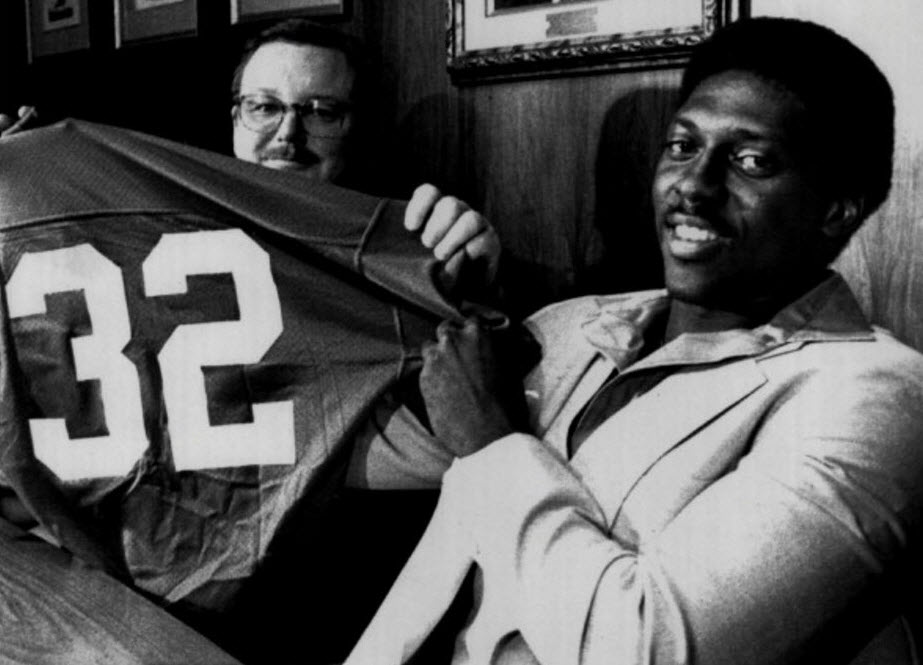
The Cardinals struck gold—twice—in the 1979 Draft when they selected running back Ottis Anderson of Miami (Fla.) and defensive back Roy Green of Henderson State, who would become two of the most prodigiously productive offensive players in team history.
The team’s top priority was a running back who had the speed and skills to run outside. In 1978, their top three backs were Jim Otis, Wayne Morris and Steve Jones—all inside power runners who accounted for 1,687 of the team’s 1,954 rushing yards (86 percent). Coach Bud Wilkinson wanted someone with breakaway speed.
Bill Bidwill welcomes Cards top draft pick O.J. Anderson in 1979.
In the weeks leading up to the Draft, the Big Red brass debated who to target with the team’s first-round pick (eighth overall): Anderson, who rushed for 3,333 yards at Miami, or Charles Alexander, who ran for 4,035 yards at LSU. Their choice of Anderson proved to be the right one.
“We feel that he has the great moves that we’ve been hunting for,” Cardinals personnel director George Boone said. “We haven’t had those in quite a while.” At least since 1977, Terry Metcalf’s last season as a Cardinal.
Several St. Louis Football Cardinals alumni met for their annual Christmas Party on Sunday, December 19 at Circa Pub & Grill in Des Peres, MO. Circa is owned by former quarterback Jamie Martin who played 16 seasons in the NFL, … Continue reading →
A golf outing and Memorial were held last week in honor of longtime Cardinals and Rams coach Jim Hanifan who passed away last November at the age of 87.
Many of Hanifan’s former players and fellow coaches attended the Thursday Memorial Service including Dan Dierdorf, Jackie Smith, Dick Vermeil, Carl Peterson, Luis Sharpe, Adam Timmerman, and dozens of others.
Jim Hanifan
Dierdorf and Vermeil gave eulogies, Jackie Smith sang Danny Boy, and countless stories were told by friends and family into the night.
On Wednesday, the first annual Jim Hanifan Memorial Top Golf outing was held to benefit Cherish. Many former players were in attendance such as Mel Gray, Johnny Roland, Joe Bostic, Irv Goode and Willard Harrell. A good time was had by all.
Hanifan’s daughter Kathy, son Jim, and grandson Austin were in town to participate in the celebration of his life.
Hanifan was the offensive line coach for the Cardinals from 1973-1978 and was head coach from 1980-1985. He later returned to St. Louis and became the offensive line coach for the Rams under Dick Vermeil in 1997 where he would remain until 2002. A couple of years later he moved to the Rams radio booth and became a beloved straight-shooting sidekick of Steve Savard. Hanifan remained in St. Louis until his death in 2020.
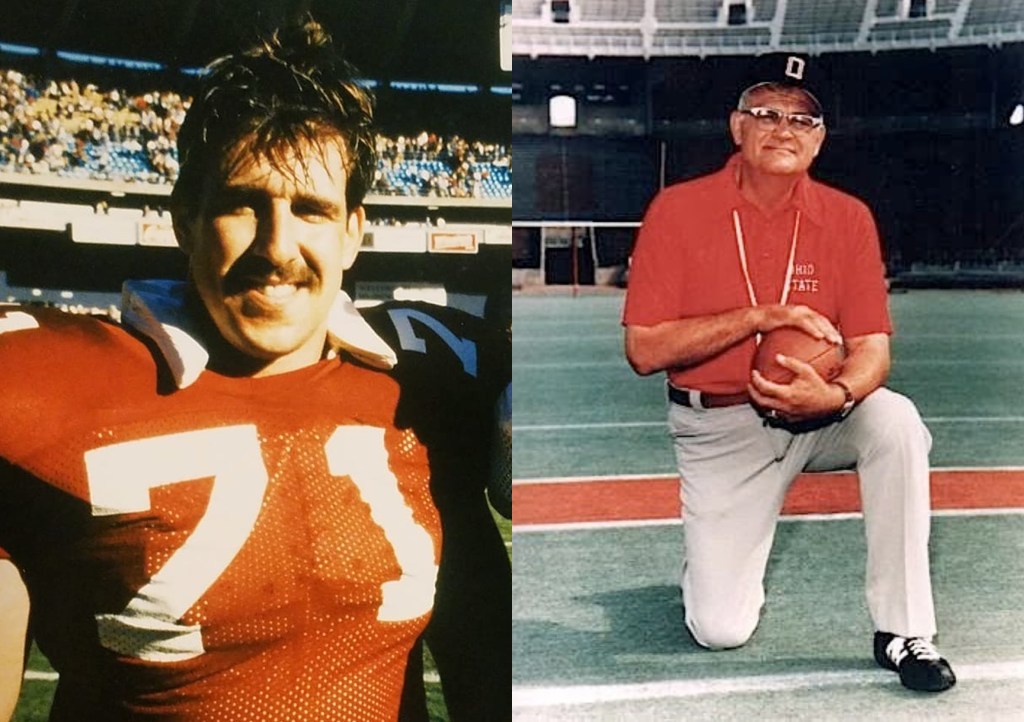
Even though he was playing in the game, Joe Bostic missed the infamous Woody Hayes punch in the 1978 Gator Bowl in Jacksonville, Fla., that led to the firing of the iconic Ohio State coach.
Bostic, a Clemson guard, was on the sideline with the rest of the Tigers’ offense when late in the game Clemson defensive lineman Charlie Bauman intercepted a pass by Ohio State quarterback Art Schlichter, essentially sealing a 17-15 Clemson victory.
After Bauman ran out of bounds on the Ohio State sideline, an enraged Hayes came up, grabbed the back of Bauman’s jersey and punched Bauman just below the neck. Penalty flags went flying as Bostic and the Clemson ran on to the field, but Bostic didn’t know what the flags were about.
When the game ended, after midnight, Bostic sprinted off the field to the locker room, where he quickly showered, dressed and departed the stadium before all of his teammates had even left the field. He had a 9 a.m. flight the next morning to Honolulu, where he would start in the Hula Bowl, and he wanted to get back to his hotel room.
Former Big Red Lineman Joe Bostic was a member of the 1979 Clemson Tiger team that defeated Woody Hayes’ Ohio State Buckeyes 17-15.
At 6 a.m. the next morning, the phone rang in Bostic’s room. It was his mother.
It was sometime between Thanksgiving and Christmas in 2014, but Joe Bostic wasn’t exactly feeling the holiday spirit. He lay in a hospital bed at his home in Greensboro, N.C., unable to straighten out his legs, both of which were in braces. Double quadriceps surgery had made the former St. Louis Cardinals offensive lineman a prisoner in his own house.
While carrying a bag up some stairs, Bostic had slipped and his right quadriceps muscle had detached from the knee. When he shifted his weight to his left knee, that quadriceps also tore.
After surgery, Bostic was confined to bed for eight weeks.
“It was unbelievable,” says Bostic, who played for the Big Red from 1979-1988. “I was like, I don’t know if I can do this. I finally said, ‘God, you get me out of this bed, I’m going to keep moving. I’m not going to sit around on my rear end. I’m going to get going.
“He got me out of that bed, so I’ve been trying to keep my word.”
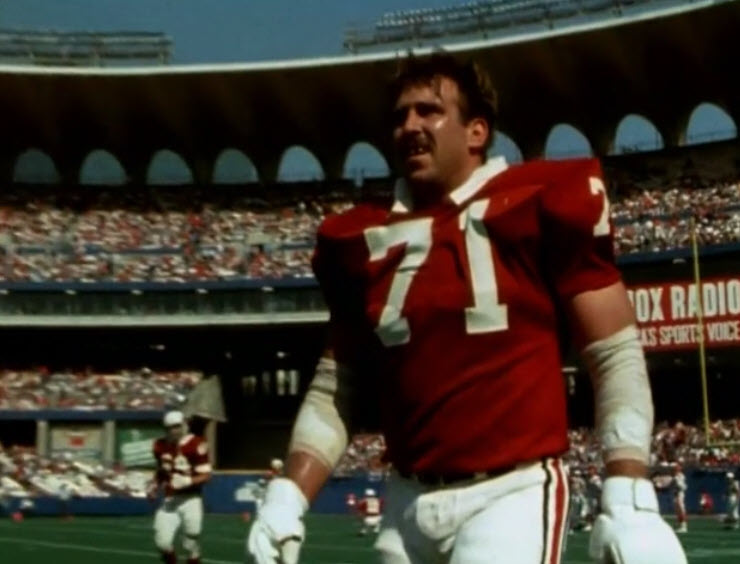
Joe Bostic played in 132 games in 9 seasons with the Cardinals.
With the NFL celebrating its centennial season in 2019, the league will soon be announcing its top 100 players of all-time. I thought it would be fun to look back and rank the Big Red’s top 100 players who played in St. Louis.
The Cardinals moved from Chicago after the 1959 season and played 28 years in St. Louis before Bill Bidwill moved to the desert in 1988. Several great players played under the arch during this period including four Hall of Famers.
These rankings are only based on the player’s time spent in St. Louis. Consideration was given to the player’s statistics, All-Pro/Pro Bowl selections, team leadership, and impact in the community. It is next to impossible to compare eras, so many of these picks were very difficult.
The Top 100 St. Louis Football Cardinals of All-Time: 60-51
60. JOE BOSTIC (G)
Joe Bostic played guard for nine seasons in St. Louis.
As former St. Louis Post Dispatch columnist Kevin Horrigan once wrote, “Joe Bostic was never a star, never an All-Pro, never a Pro Bowler. He was just a pretty good player, mostly on some pretty bad teams.” Bostic was the Cardinals 3rd round draft pick out of Clemson in 1979 and became a fixture on the Big Red offensive line for nine seasons. The North Carolina native made his first NFL start against the Pittsburgh Steelers playing across L.C. Greenwood. He was named to the NFL All-Rookie team in 1979. Bostic’s best season came in 1984 when he started all 16 games to help lead the Cardinals to a 9-7 record.
According to a study in 2017, chronic traumatic encephalopathy (CTE) was found in 99% of deceased NFL player’s brains that were donated to science. CTE has been linked to repeated blows to the head which is, obviously, is very common among NFL players, in particular, offensive and defensive linemen.
Last year, Jeff Meyers, who covered the Football Cardinals in the early 1970s for the St. Louis Post Dispatch, and former Big Red Pro Bowl Center, Tom Banks, collaborated on an unscientific study of 23 former pot-smoking Cardinals who regularly lit-up during the season and sometimes before games. Meyers became curious of how they were doing after watching the movie “Concussion” in 2016.
The results of the “anecdotal evidence” were published in the Winter/Spring 2017 edition of O’Shaughnessy’s, the Journal of Cannabis in Clinical Practice. The story has been re-printed below with Mr. Meyers’ permission. While most of the players wanted to remain anonymous, a few such as Conrad Dobler, Dale Hackbart, and Banks shared some of their experiences with concussions and how the use of marijuana helped them cope with injuries.







 THE BIG RED ZONE