Big Red Draft: All-Time Picks by Round

Posted by Bob Underwood

Most people are aware of the historic struggles the St. Louis Cardinals had when it came to the NFL draft. There were some very good drafts over the years (1979-1983 for example), but more times than not, the Big Red left their fans scratching their heads (“They drafted a girl!”).

I thought it would be fun to go back and rank the all-time Big Red draft picks by round. Many on this list were no-brainers, but there were a few very competitive rounds. I’m sure everyone will agree that some of the greatest names in Cardinals history are on this list, including four Cardiac Cards offensive lineman, and all four Hall of Famers. But I also learned something about the Cards top 16th and 20th round picks, Jimmy Lee Hunt and Tom Day. Both were released by the Cardinals and both went on to become stars in the AFL. Hope you enjoy!


ALL-TIME ST. LOUIS CARDINAL DRAFT PICKS BY ROUND

ROUND 1 – ROGER WEHRLI (1969)

Wehrli was a consensus All-American at Missouri when the Cards selected him with the 19th pick in the draft. He went on to a 14 year career in St. Louis that included 3 All-Pro and 7 Pro Bowl selections. He had 40 interceptions, 19 fumble recoveries and was the longtime holder for Big Red kickers. He returned a fake FG for a TD in his final NFL game in 1982. Roger Staubach called him the best cornerback he ever played against. Wehrli was inducted to the Pro Football Hall of Fame in 2007, a member of the College Football Hall of Fame and the 1970s NFL All-Decade Team.

Continue reading

Big Red Drafts: Larry Stegent

Posted by Bob Underwood

Picking eighth in the 1970 NFL draft, the St. Louis Football Cardinals selected running back Larry Stegent out of Texas A&M.

“It’s unbelievable—I’m overwhelmed,” Stegent said in a St. Louis Post Dispatch interview after the draft. “I didn’t feel I’d be picked until much later. I didn’t really think anyone wanted me that much.”

Stegent was an All-American high school halfback and Southwest Conference all-star his sophomore and junior seasons at A&M. The Houston native was slowed by injuries for much of his senior season, but that didn’t stop the Cardinals from drafting him ahead of All-American running back Steve Owens from Oklahoma.

“Owens is a straight-ahead type runner,” Big Red head coach Charley Winner said. “We think Stegent can go outside for us, and he’s a good pass receiver.

Unfortunately, Stegent would never “go outside” for the Cards and became yet another Cards first round disappointment.

Larry Stegent was a high school and college star at Texas A&M when the Cardinals drafted him with the 8th pick in the 1970 draft.
Continue reading

Forgotten Big Red Star: Bob Reynolds

Posted by Bob Underwood

While the Big Red offensive line of the 1970s gets all the glory, the front five of the 1960s Cardinals was just as good and may have been better. Bob DeMarco, Irv Goode, Ken Gray, Ernie McMillan, and Bob Reynolds combined for 19 Pro Bowls from 1961-1970.

The 6′-6, 265-pound Reynolds was the Cards second round draft choice in 1963 out of Bowling Green where he was a two-time all-conference selection. He started his first training camp on defense, but was moved to left tackle after a string of injuries on the offensive line.

Big Red line coach Ray Prochaska believed Reynolds had the tools to succeed on the offensive line.

“He seems to know what pass protection is about. He knows the footwork pretty well and knowing this is three-fourths of the task.”

Bob Reynolds played left tackle 9+ seasons for the St. Louis Cardinals.

Reynolds had another reason for the move to offense

“I didn’t feel I was good enough to be a defensive tackle,” he told Jeff Meyers of the St. Louis Post Dispatch in 1970. “All the way up to pro ball I was always bigger than most players. I may have loafed. I had the tendency to take it easy. In college all I knew about defense was to overpower everybody.”

Reynolds told Meyers that he became convinced that mental preparation was the most important factor of playing on the offensive line.

“That is how you beat your opponent,” he said. “Better shape? No, you beat him because you’ve prepared yourself more than he has. Strength? No, you beat him because you prepared yourself more.”

Continue reading

Big Red Legends: Charley Trippi

The oldest living member in the Pro Football Hall of Fame rose from his chair, eyed his target squarely and moved in for the play. With his wife, Peggy, cheering him on, he huffed, and he puffed, and he blew out every one of the 99 candles on his birthday cake.

His health may be betraying him—his hearing is shot, his mobility is compromised, and he fell and broke his shoulder while walking out to the mail box a few months ago—but Charley Trippi hasn’t lost the singular trait that defined his magnificent football career, where he was a multi-dimensional player at the University of Georgia and in the NFL.

“I’ve never met a man more determined than my grandpa,” says Clint Watson. “If you go back and look at all the pictures of him in action, you’ll see a similarity. You’ll see the face that he’s making. He’s gritting his teeth and straining with every ounce of energy and determination that he has. When you see those pictures, you’re like, ‘That’s Pa-Pa.’ He has a determination about him that a lot of people just don’t have.”

Trippi lives in Athens, Ga., not far from the college stadium where he starred in the mid-1940s. You used to be able to drive by his house and see Charley out in his yard, raking leaves. But he pretty much stays inside any more.

Born on December 14, 1921 in Pittston, Pa., Trippi was the son of a Sicilian immigrant coal miner. His mother died when Trippi was young. Trippi played football at Pittston High School, but he felt he needed to add some weight before playing in college.

Continue reading

Big Red Flashback: Vai Sikahema Returns Two Punts for TDs in 1986 Game

Posted by Bob Underwood

“Thank goodness for little return people,” Big Red head coach Gene Stallings said after the Cardinals defeated the Tampa Bay Buccaneers 21-17 to close out the 1986 season.

The “little return people” Stallings was referring to was 5 foot 8 inch Vai Sikahema who had just become the fifth player in NFL history to return two punts for TDs in one game.

The Cardinals and Buccaneers were arguably the two worst teams in the NFL in 1986 and they certainly lived up to that billing on this cold Sunday afternoon at Busch Stadium. The teams combined for 15 punts, 6 turnovers, and 500 total yards.

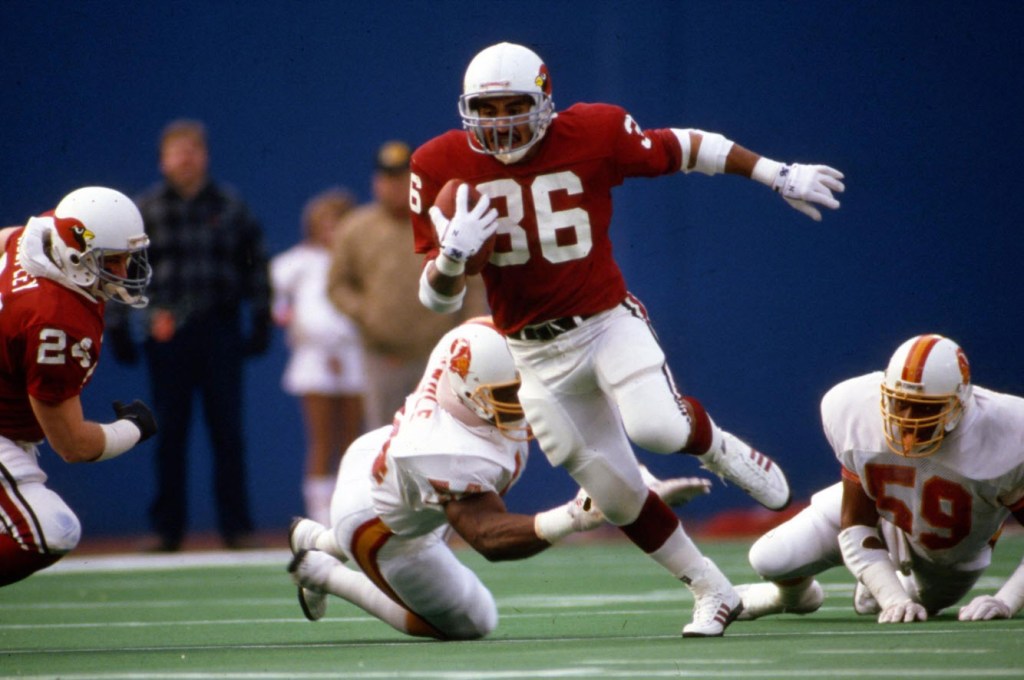
Vai Sikahema returning a punt 71 yards for a touchdown. He would return another 60 yards for a TD minutes later.

The Cardinals struggled on offense, turning the ball over three times and missing three easy field goals. They converted on only one of 10 third down plays and entered Tampa territory nine times, coming away with only one offensive touchdown.

Continue reading

Forgotten Big Red Star: Dale Meinert

Bill Bidwill called him “one of the great defensive players we had.”

Dale Meinert was a three-time Pro Bowl middle linebacker with the Cardinals from 1958-1967. He was a college star at Oklahoma A&M (now Oklahoma State) and was drafted by the Baltimore Colts in 1955. But instead of playing in the NFL, the Lone Wolf, Oklahoma native decided to play in the CFL for Frank “Pop” Ivy and the Edmonton Eskimos, where he won a Grey Cup Championship.

Dale Meinert played 10 seasons with the Cards

In1958, after spending a couple of years in the Air Force, Meinert rejoined Pop Ivy with the NFL Chicago Cardinals. He played offensive line his first two seasons, but defensive coordinator Chuck Drulis converted him to linebacker in 1960.

“I guess they figured I wasn’t big enough to play guard,” the 215 pound Meinert said in Bob Burnes book Big Red, “and I sort of agreed with them because those defensive tackles kept looking bigger and bigger.”

It was a decision the Cardinals and Meinert would not regret. The tall rangy linebacker intercepted a pass in his first start against the Rams in 1960 and quickly developed into an aggressive tackler and pass defender. He was named team MVP in 1961 and earned Pro Bowl selections in 1963, 1965, and 1967. He did a brilliant job quarterbacking the Big Red defense and calling all the plays.

Continue reading

The Rise of Charley Johnson

(Editor’s note: This story is a reprint from the January 1966 issue of Sport Magazine and was written by John Devaney.)

In sports, some success stories begin with a dream. Here is how one dream of playing professional football came true — at almost impossible odds.

By JOHN DEVANEY

The quarterback was sitting bare-chested, on the edge of the rubbing table. He was holding a white towel to his face, and a large crimson stain was slowly spreading over the towel because blood was pouring from a gash in his chin. The quarterback didn’t seem to notice the blood. He was staring at the floor with the rapt concentration of someone watching scenes from his life flash, one by one, on a movie screen.

This was Charley Johnson, St. Louis Cardinal quarterback, in the visitor’s clubhouse at Yankee Stadium one afternoon late this October. Minutes before he had run off the field, plunging almost blindly through the swirling crowd, after New York had beaten St. Louis 14-10. Twice in the game’s closing minutes Johnson had brought the Cardinals inside the Giant 25, and twice he had failed to get the touchdown that would have won.

Continue reading

Cardinal Great Larry Wilson Passes Away at 82

It’s been a rough couple of weeks for St. Louis sports fans. We lost baseball Hall of Famer Lou Brock on September 6 and on Friday we learned of the passing of former Big Red great Larry Wilson.

Wilson played college ball at the University of Utah and was the Chicago Cardinals 7th round draft choice in the 1960 NFL draft. He went on to a 13 year Hall of Fame career in St. Louis.

The Rigby, Idaho native played in 8 Pro Bowls and was named first team All-Pro five times. He was selected to the NFL 1960s All-Decade Team, the 75th Anniversary Team, and the NFL 100 All-Time Team. Wilson was the NFL Defensive Player of the Year in 1966 and is the all-time Cardinals leader in interceptions with 52. He was inducted into the Pro Football Hall of Fame in 1978.

Wilson was a member of the Cardinals organization as a player, coach, and executive for over 40 years. He was inducted into the team’s Ring of Honor in 2006.

Arizona Cardinals owner Michael Bidwill had this to say about Wilson.

“Besides my father, Larry Wilson was the most influential male figure in my life. He was someone who truly lived his faith and demonstrated it daily in the kindness he showed every single person he met. Any of us lucky enough to be in his orbit – whether that was for a few minutes or four decades – was always better off from the experience. I will remember Larry Wilson first as a fantastic person but then obviously as one of the greatest players the National Football League has ever seen. It’s fitting that his passing coincides with the league’s 100th birthday because his toughness and the way he revolutionized his position make him one of our game’s most unforgettable figures. Whether on the field playing with casts on both hands or brightening the lives of every person he knew, Larry’s selflessness defined who he was and how we will all remember him.”

Larry Wilson is survived by Nancy, his wife of 40 years, as well as daughter Christie, son Larry Jr., numerous grandchildren and one great-grandchild.

Joe Bostic Remembers Humorous Encounter With Woody Hayes

Even though he was playing in the game, Joe Bostic missed the infamous Woody Hayes punch in the 1978 Gator Bowl in Jacksonville, Fla., that led to the firing of the iconic Ohio State coach.

Bostic, a Clemson guard, was on the sideline with the rest of the Tigers’ offense when late in the game Clemson defensive lineman Charlie Bauman intercepted a pass by Ohio State quarterback Art Schlichter, essentially sealing a 17-15 Clemson victory.

After Bauman ran out of bounds on the Ohio State sideline, an enraged Hayes came up, grabbed the back of Bauman’s jersey and punched Bauman just below the neck. Penalty flags went flying as Bostic and the Clemson ran on to the field, but Bostic didn’t know what the flags were about.

When the game ended, after midnight, Bostic sprinted off the field to the locker room, where he quickly showered, dressed and departed the stadium before all of his teammates had even left the field. He had a 9 a.m. flight the next morning to Honolulu, where he would start in the Hula Bowl, and he wanted to get back to his hotel room.

Former Big Red Lineman Joe Bostic was a member of the 1979 Clemson Tiger team that defeated Woody Hayes’ Ohio State Buckeyes 17-15.

At 6 a.m. the next morning, the phone rang in Bostic’s room. It was his mother.

“Woody Hayes got fired,” she said.

“Really? Wow,” said Bostic

Continue reading

Johnny Roland: All He Does Is Win Football Games

(Editor’s Note: This story was authored by former St. Louis Globe Democrat sports writer Rich Koster and was originally published in Sport Magazine in July 1967)

To appreciate Johnny Roland’s talent, you must be aware of his shortcomings. In a game dominated by specialists, he has no specialty. He’s not as fast as Gale Sayers, as quick as Leroy Kelly, or as powerful as Ken Willard. He’s never run a 10 second 100 and when he throws a football it frequently wobbles or floats. On the longest run of his rookie year, a mere 50 yards from scrimmage, he was hauled down from behind in the open field. He tabulated over 80 yards rushing in only one game and he average an unspectacular 3.6 yards per carry over the season.

So how did the 6-2, 215-pound Roland emerge as the NFL’s Rookie of the Year? And what made him worth a $300,000 bonus contract to the St. Louis Cardinals?

Simple. He wins football games. He wins them the way Frank Gifford used to. And Paul Hornung. With the relentlessness of that 3.6 yard average and the lighting of the big play. He succeeds with versatility. He wins with his head . . . and heart.

A confirmed non-specialist in a world of specialists, Johnny Roland has his shortcomings on the football field. He doesn’t move too fast, he can’t run over people and he throws a wobbly option pass

“Some guys in this league play three or four games a season,” suggest Abe Stuber, who excavates college material for St. Louis. “Roland has shown he plays them all. He gives 100 percent all the time.. That puts him in a different category from the others.”

Continue reading