Rigby resident raising money to honor Larry Wilson

Larry Wilson was a humble man, from humble beginnings who never forgot where he came from. Wilson was born and raised in the small town of Rigby, Idaho and would later become the greatest athlete in Rigby High School history, earning 16 Letters in football, baseball, basketball and track. Larry went on to star at the University of Utah and then with the St. Louis Cardinals of the National Football League.

On July 7, 1967, the town honored Larry Wilson by retiring his high school number 7 and naming their football field “Larry Wilson Field.” Over 300 friends and acquaintances of Larry descended on Rigby to help honor “Willy.” Even Cardinals vice president Bill Bidwill flew in unexpectedly to participate in the celebration.

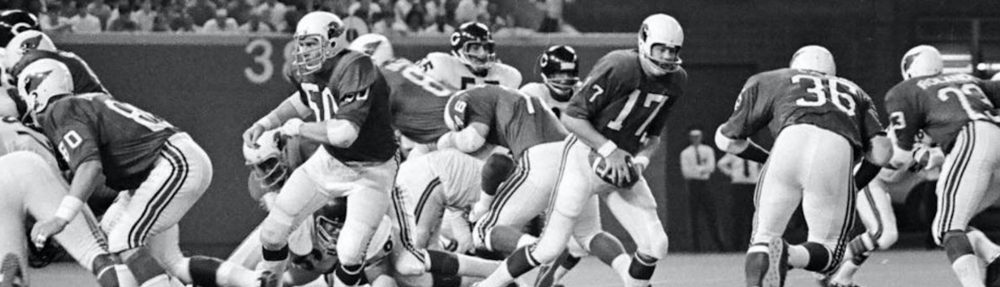
Larry Wilson is carried off the field by teammates after his last NFL game in 1972.

According to Wilson family friend, Michelle Barber, the name Larry Wilson Field was supposed to remain in perpetuity. However, when the new high school was built in the early 1990s, Larry’s name was removed and replaced with the name of a local doctor who never played ball in Rigby.

Michelle grew up watching Larry play football and said she and her late father, Dean Allgood, would watch the Cardinals whenever they were on television. Dean was a good friend of Whitey Wilson (Larry’s father) and the family felt terrible when Larry’s name was removed from the field.

Continue reading
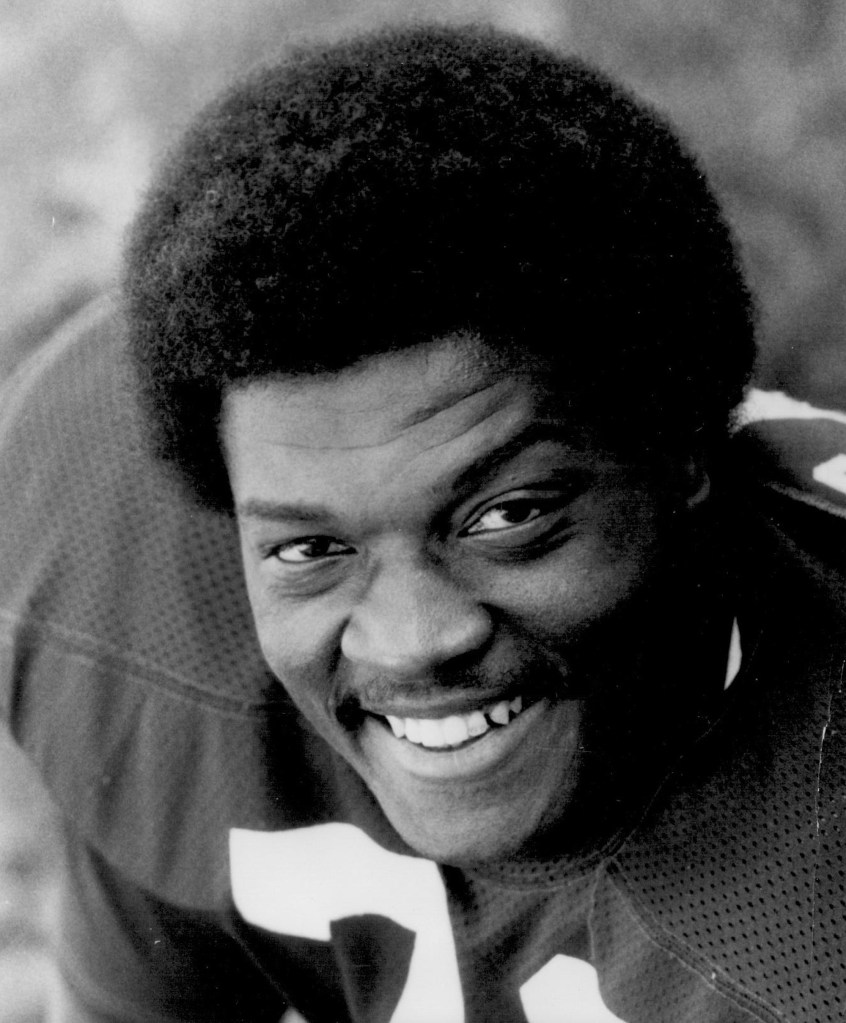
Big Red Characters: “Dr. Doom” John Barefield

Posted by Bob Underwood

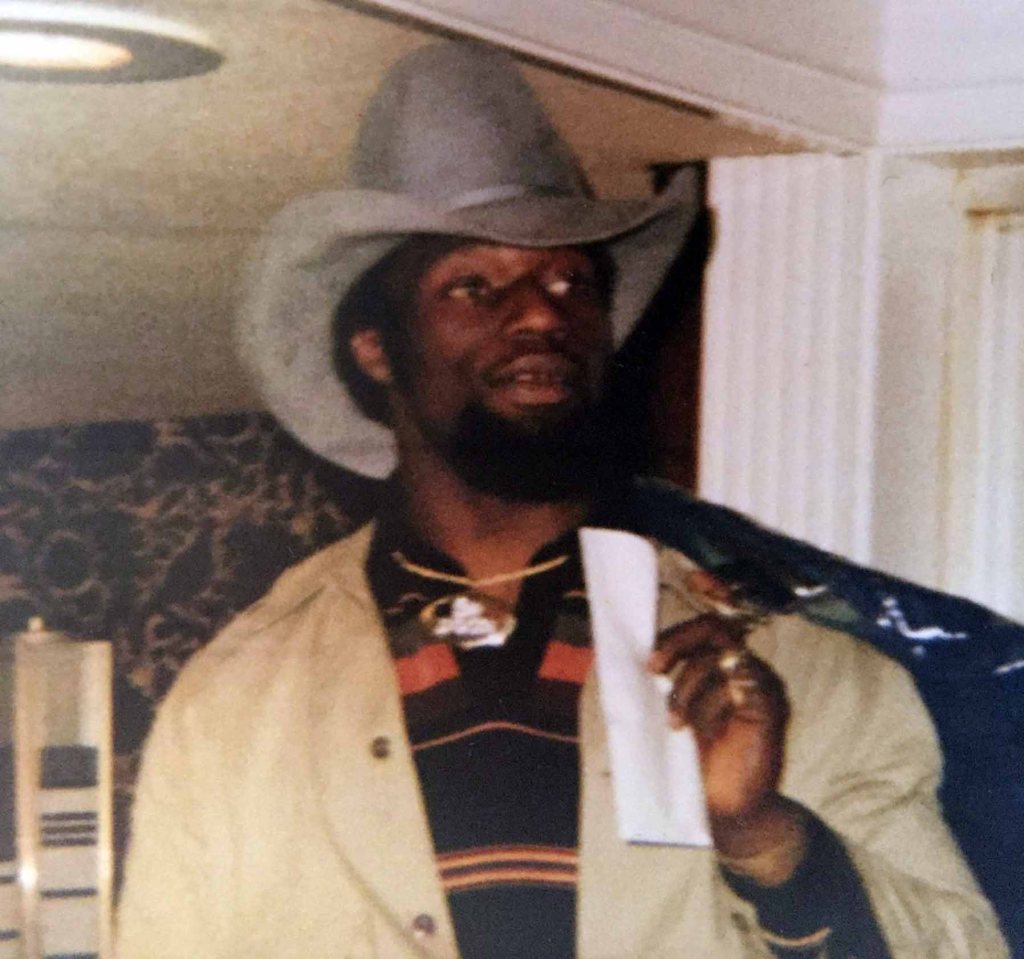
John Barefield spent only three seasons with the St. Louis Cardinals, but with all due respect to Conrad Dobler, there may not have been a larger character. The 6-foot-2, 230-pound linebacker was the Cards second-round draft pick in 1978 out of Texas A&I University where he was known for wearing quarters in his ears, stalking cemeteries at night, writing poetry about his tackles, and going by the name of Doctor Doom.

John “Dr. Doom” Barefield played with the Cardinals from 1978-1980 (Photo courtesy of Paul Turner)

“I know I’m strange. I’ve got a strange mind,” the flamboyant linebacker said at a rookie workout at Busch Stadium in 1978. “I see visions, vibes and things. I was going to leave my Dr. Doom cap back at college, but I found myself putting it back on.”

Continue reading

Big Red Flashback 1982: Stump’s Big Day in Philly

Posted by Bob Underwood

Stump Mitchell rushed for 1,647 yards his senior season at The Citadel, second in the nation to South Carolina’s George Rogers who was rewarded with the Heisman Trophy and selected as the first overall pick in the 1981 NFL draft.

Meanwhile, Stump waited patiently for the telephone to ring while running backs were coming off the board left and right.

“I was waiting and praying,” the 5-foot-8 190 pound Georgia native told the St. Louis Post Dispatch in a 1981 interview..

Lyvonia Albert Mitchell

Late in the second day of the draft, Stump picked up the ringing phone and heard St. Louis director of pro personnel Larry Wilson telling him, “Congratulations, you’ve been selected by the St. Louis Cardinals.” In response, Stump couldn’t contain his mood.

“He was mad,’ Wilson remembered. “He told Jim Hanifan (then Cardinals head coach) and me, both of us, that he was going to make our ball club, that he was better than a ninth-round choice, that he was going to make us forget about Ottis Anderson.”

Continue reading

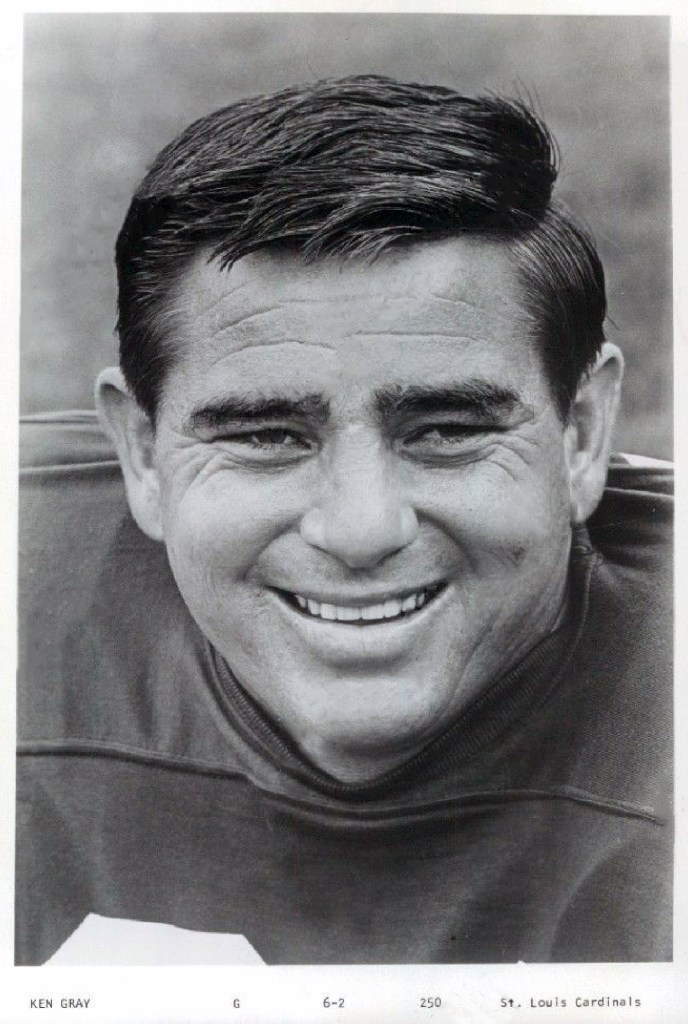
Forgotten Big Red Stars: Ken Gray

Posted by Bob Underwood

Ken Gray was part of the greatest draft class in Green Bay Packers history. The Texas native was taken in the 6th round of the 1958 draft along with future Hall of Famers Jim Taylor, Ray Nitschke, and Jerry Kramer. The Packers also nabbed future All-Pro linebacker Dan Currie.

Ken Gray was a 6x Pro Bowl guard with the Cardinals from 1958-1969.

Gray and Kramer battled for a roster spot throughout training camp. A coach actually told Kramer that he would probably be traded because they had too many guards. But it ended up being Gray who was among the last cuts just before the start of the season. After his release, Packer head coach Ray “Scooter” McLean told Gray that he “would play somewhere in this league.”

“My heart went to my feet,” Gray said in a 2015 story in the Picayune, but what could I say? Those experiences make you a better person and better player.”

Based on the talent of both Kramer and Gray, the Packers should have kept both players as they would have made quite a tandem at guard over the next several years. The Packers went 1-10-1 in 1958 and McLean was fired and replaced with Vince Lombardi.

Meanwhile, Gray signed with the Chicago Cardinals and played defense his rookie season. He was moved back to guard in 1959, gained 30 pounds and was named to his first Pro Bowl two years later.

Continue reading

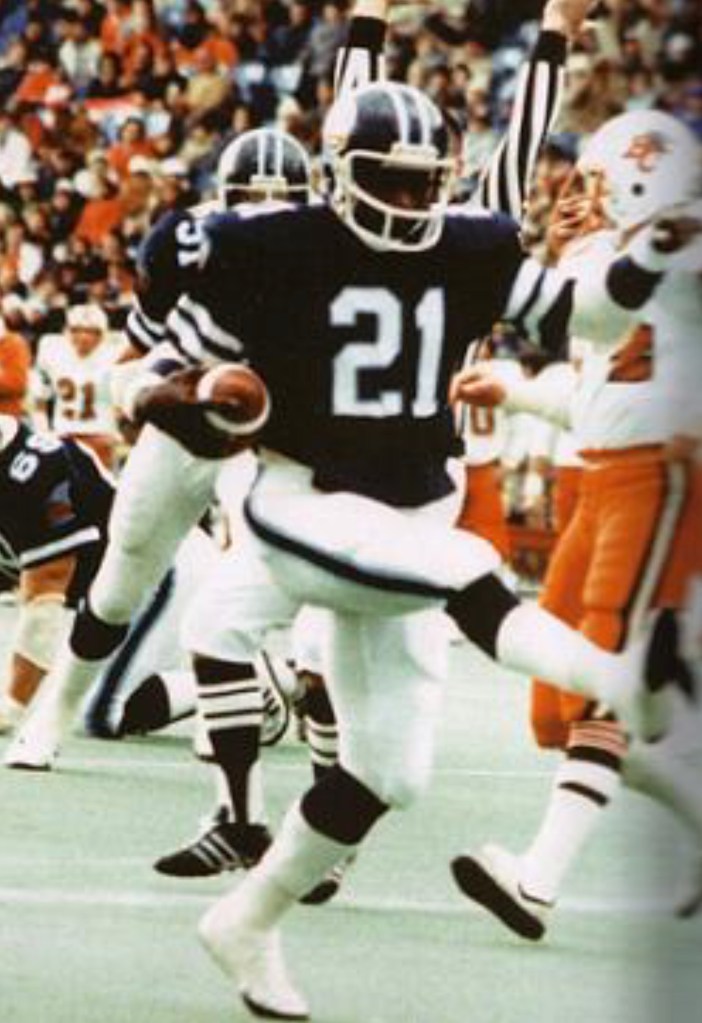
Why Terry Metcalf Left the Cardinals for the CFL

“Best of luck to him,” Cardinals director of operations Joe Sullivan told the St. Louis Post Dispatch after star running back Terry Metcalf announced he was taking his talents to the Canadian Football League in March of 1978. “Money is a great thing to have in life when you’re young.”

Metcalf signed a seven-year, $1.4 million contract with the Toronto Argonauts after turning down a 3-year, $240,000 offer from the Cardinals and curiously similar proposals from other NFL teams. Metcalf was looking for a reported $300,000 yearly contract.

“I wouldn’t have made as much in five years in St. Louis as I’ll make in one year in Toronto,” Metcalf told the St. Louis Post Dispatch after the deal was announced. “I laid in bed all Saturday night thinking about it. There were a lot of doubts in my mind, but I have to do what’s right for me.”

Metcalf added, “I thought I would still be in the NFL, but nobody seemed willing to want to talk. So I had to look elsewhere.”

The 26-year-old Metcalf was known as “The Franchise” in St. Louis and was the Cardinals’ third-round draft choice in 1973 out of Long Beach State. He quickly became one of the greatest all-purpose backs the game had ever seen.

In 1974, Metcalf became the first NFL player to average 30 yards per kick return and 10 yards per punt return in the same season. The following year he set an NFL record with 2462 combined yards and became one of only four players to account for touchdowns by rushing, receiving, kick return, punt return, and passing in a season.

“He did everything for us except drive the bus to the stadium,” Dan Dierdorf said of Metcalf in a 2018 interview on KFNS radio.

Continue reading

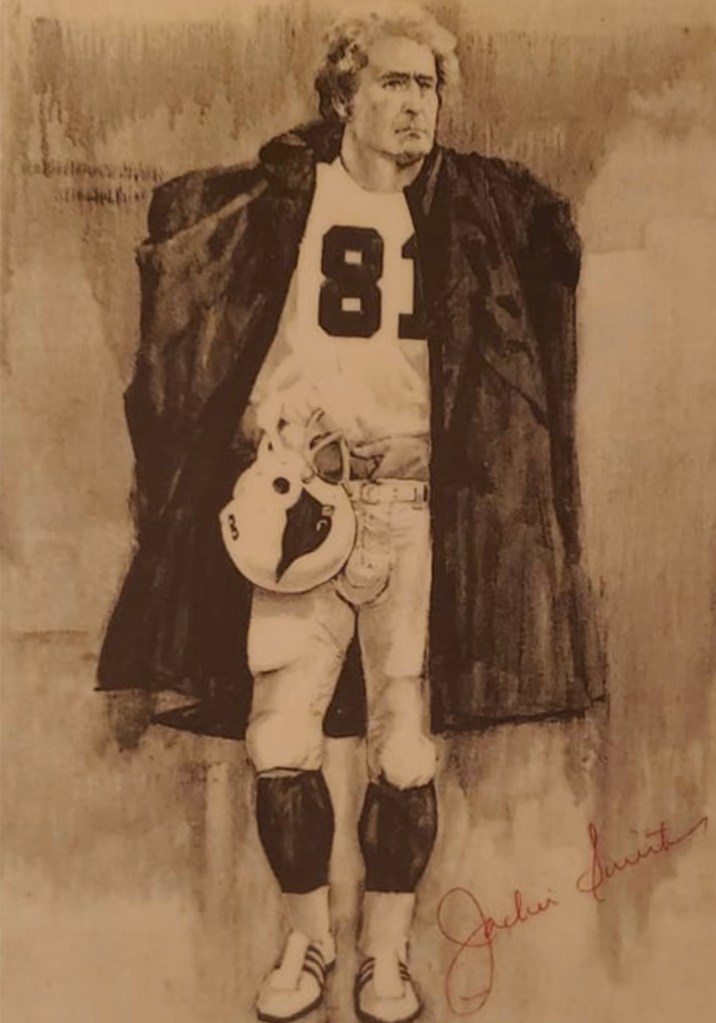
Emotional Moments from Jackie Smith’s Hall of Fame Induction

(Editor’s Note: This is a reprint of a story written by Howard Balzer on August 3, 1994 about Jackie Smith’s induction into the Pro Football Hall of Fame)

MAKING A HALL by Howard Balzer

Canton, Ohio—Friends, fans and family.

On another sun-splashed Saturday in the city where professional football was born, a new class of the game’s greats was enshrined in the Pro Football Hall of Fame.

Friends, fans and families came from far and wide to honor them and show their love. Emotions were high as even the most stone-faced among them broke down. No matter what was said beforehand, the new Hall of Famers become overwhelmed by the moment, by the hospitality of the volunteers, by the fans lined deep on the sidewalks waving during the parade Saturday morning.

For Jackie Smith, the weekend was a whirlwind of non-stop action. He seemed to be operating on adrenaline alone, overcome by what is happening, surrounded by friends, fans and family.

Friends: They came from everywhere, including teammates Charley Johnson, Jim Hart, Larry Stallings, Bill Koman, Terry Miller, Steve Jones, Tim Kearney, Kurt Allerman.

Continue reading

Big Red Legends: Ernie McMillan

Posted by Bob Underwood

Ernie McMillan grew up in Chicago, where he lettered in baseball, basketball, and football at DuSable High School. He attended the University of Illinois but didn’t play much in his first three years.

“I had wanted to go to Arizona or some other college far away, but my mother didn’t want me to be too far from home,” Ernie said in a Post Dispatch story in 1969.

McMillan was used primarily as a blocking tight end at Illinois and caught only 7 passes in his college career, but the Cards drafted him in the 13th round of the 1961 NFL draft. The 6-foot-6 McMillan reported to camp at 283 pounds and requested to switch to tackle just a few days into practice. The Big Red agreed, and neither would regret it.

Ernie McMillan was a four time Pro Bowl tackle for the Big Red from 1961-1974.

“When Billy Bidwill came to Illinois to sign me, I told him I didn’t think I could make the team,” McMillan told attendees at the annual kickoff luncheon in 1961. “I taught school for six months and I realized there had to be a better and easier way to make a living, so here I am.”

Continue reading

Big Red Flashback 1965: Why the Cards traded John David Crow

Posted by Bob Underwood

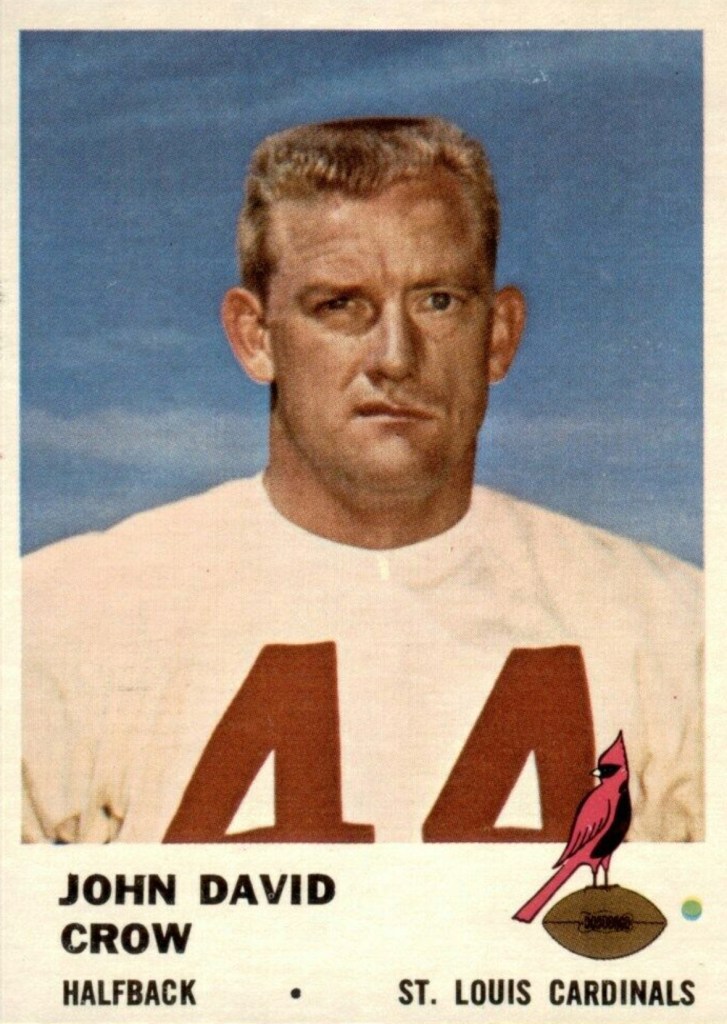
Frustrated about lack of playing time under head coach Wally Lemm, Big Red star running back John David Crow requested a trade after the 1964 season.

Crow won the Heisman trophy at Texas A&M in 1958 and was later the Chicago Cards first pick in the NFL draft. The team moved to St. Louis in 1960 where Crow became a star. His 1,533 total yards and 5.9 yards per carry were tops in the league in 1960 and he scored scored 17 touchdowns in 1962.

However, Crow struggled with injuries during his time in St. Louis. In 1961 he suffered a broken leg. In 1963 a knee operation limited him to just nine carries.

John David Crow was the Cardinals top pick in the 1958 NFL Draft.
Continue reading

Big Red Draft: All-Time Picks by Round

Posted by Bob Underwood

Most people are aware of the historic struggles the St. Louis Cardinals had when it came to the NFL draft. There were some very good drafts over the years (1979-1983 for example), but more times than not, the Big Red left their fans scratching their heads (“They drafted a girl!”).

I thought it would be fun to go back and rank the all-time Big Red draft picks by round. Many on this list were no-brainers, but there were a few very competitive rounds. I’m sure everyone will agree that some of the greatest names in Cardinals history are on this list, including four Cardiac Cards offensive lineman, and all four Hall of Famers. But I also learned something about the Cards top 16th and 20th round picks, Jimmy Lee Hunt and Tom Day. Both were released by the Cardinals and both went on to become stars in the AFL. Hope you enjoy!


ALL-TIME ST. LOUIS CARDINAL DRAFT PICKS BY ROUND

ROUND 1 – ROGER WEHRLI (1969)

Wehrli was a consensus All-American at Missouri when the Cards selected him with the 19th pick in the draft. He went on to a 14 year career in St. Louis that included 3 All-Pro and 7 Pro Bowl selections. He had 40 interceptions, 19 fumble recoveries and was the longtime holder for Big Red kickers. He returned a fake FG for a TD in his final NFL game in 1982. Roger Staubach called him the best cornerback he ever played against. Wehrli was inducted to the Pro Football Hall of Fame in 2007, a member of the College Football Hall of Fame and the 1970s NFL All-Decade Team.

Continue reading

Big Red Drafts: Larry Stegent

Posted by Bob Underwood

Picking eighth in the 1970 NFL draft, the St. Louis Football Cardinals selected running back Larry Stegent out of Texas A&M.

“It’s unbelievable—I’m overwhelmed,” Stegent said in a St. Louis Post Dispatch interview after the draft. “I didn’t feel I’d be picked until much later. I didn’t really think anyone wanted me that much.”

Stegent was an All-American high school halfback and Southwest Conference all-star his sophomore and junior seasons at A&M. The Houston native was slowed by injuries for much of his senior season, but that didn’t stop the Cardinals from drafting him ahead of All-American running back Steve Owens from Oklahoma.

“Owens is a straight-ahead type runner,” Big Red head coach Charley Winner said. “We think Stegent can go outside for us, and he’s a good pass receiver.

Unfortunately, Stegent would never “go outside” for the Cards and became yet another Cards first round disappointment.

Larry Stegent was a high school and college star at Texas A&M when the Cardinals drafted him with the 8th pick in the 1970 draft.
Continue reading