Unknown's avatar

About Dennis Dillon

Dennis covered the St. Louis Football Cardinals at the St. Louis Globe Democrat and was a longtime staff writer at The Sporting News.

The Next Great Quarterback

Marino, Montana May Have To Make Room For Neil Lomax

(Editor’s Note: This is a reprint of a Dennis Dillon article from the September 23, 1985 edition of The Sporting News)

Over the years, quarterbacks have formed the Ursa Major in the National Football League’s galaxy of stars.

In the 1960s, Johnny Unitas and Bart Starr were the luminaries. Terry Bradshaw, Roger Staubach and Fran Tarkenton shown as brightly as anyone in the next decade. Thus far in the ‘90s, indelible prints have been left by Joe Montana and Dan Marino.
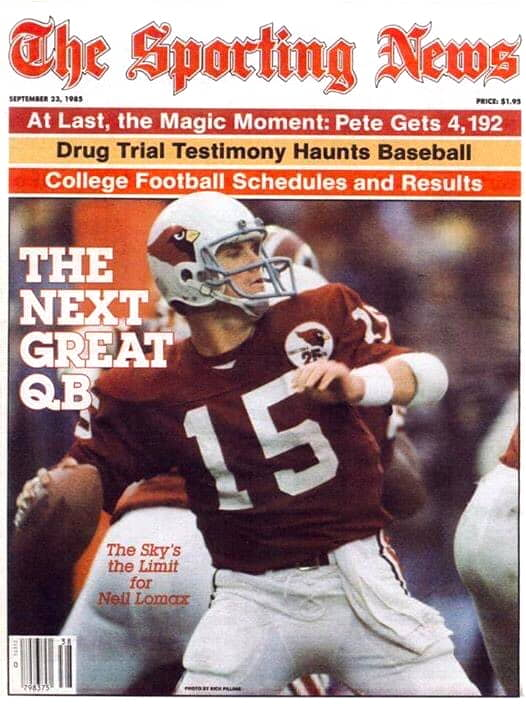
But a new star is rising. He began his ascent gradually, then shot into the constellation last year.

That star is the St. Louis Cardinals’ Neil Lomax, the latest in the NFL’s lineage of passing princes.

Lomax clearly exhibited credentials last season, throwing for 28 touchdowns and 4,614 yards and compiling the NFL’s fourth-best passer rating (92.5). He was fifth in completion percentage (.616) and sixth in yards per attempt (8.24).

Montana and Marino wound up as the leading men in Super Bowl XIX and, afterward, a Pepsi commercial. Lomax then adjourned to less-than-cosmopolitan West Linn, Oregon, where he spent a predominantly quiet off-season clutching golf clubs and fishing rods.

And there’s the disparity. Montana and Marino have become celebrities off the field. Lomax’s star? After the season, it sets rather inconspicuously in the Pacific Northwest.

Continue reading

Big Red Flashback: Cards-Vikings Faced Off in London in 1983

When the Jacksonville Jaguars play the Atlanta Falcons on October 1 at Wembley Stadium in London, it will mark the 43rd time the NFL has held a regular-season or preseason game on British soil.

The first time was 40 years ago today (August 6, 1983), when the Cardinals met the Minnesota Vikings in the Global Cup. It was the brainchild of John Marshall, a former Hollywood screenwriter whose International Promotions Limited company sponsored the exhibition game. The Super Bowl had been televised in England for the first time the previous January—viewers stayed up into the wee hours of the morning because of the time difference—and Marshall believed there was interest to be mined in American football.

Quarterbacks Jim Hart (L) and Tommy Kramer meet at the 50-yard line at Wembley Stadium on August 6, 1983.

The Global Cup was played on a Saturday. The Cardinals, who had been practicing for a few weeks at training camp at Eastern Illinois University in Charleston, flew out of St. Louis on a Global Airlines 707 charter that departed Lambert Field at around 7 p.m. Thursday and arrived at London’s Gatwick Airport at 10 a.m. Friday London time—some nine hours later. 

“It was a long, long, long flight,” former Big Red guard Joe Bostic recalled recently. 

Continue reading

Big red Draft History: 1987 NFL Draft

The Big Red Zone concludes its series looking back on each of the 28 St. Louis Cardinals drafts (1960-87). This installment focuses on the 1987 Draft, which was held April 28-29 in New York.

Undeterred by three previous failed attempts at finding an elite quarterback in the first round of the NFL Draft (George Izo, 1960; Joe Namath, 1965; and Steve Pisarkiewicz, 1977) the Cardinals took one more swing in their final draft in St. Louis and selected Kelly Stouffer with their first-round pick in 1987.

In three seasons at Colorado State, Stouffer passed for 7,142 yards and 36 touchdowns. He was a first-team All-Western Athletic Conference pick as a senior. And he was named the most outstanding offensive player in the East-West Shrine All-Star Game. 

Despite that resume, several other quarterbacks had been rated higher than Stouffer, and many NFL scouts were surprised that the Big Red deemed him worthy of the sixth selection overall.

“We wouldn’t have taken him if we didn’t think he was,” said George Boone, the Cardinals’ director of personnel. “He may be even better than that. But time is going to determine that one.”

Continue reading

Big Red Draft History: 1986 NFL Draft

The Big Red Zone continues its series by looking back on each of the 28 St. Louis Cardinals drafts (1960-87). This installment focuses on the 1986 Draft, which was held April 29-30 in New York.

Going into the 1986 NFL Draft, Gene Stallings knew defensive end was a priority for the Cardinals.

The team Stallings had inherited after succeeding Jim Hanifan as the team’s head coach had put up some disturbing defensive numbers in 1985: 34 touchdown passes allowed (most in the NFL), 13 interceptions (fewest), and 32 sacks (second to last). Only 13 of those sacks came from defensive ends.

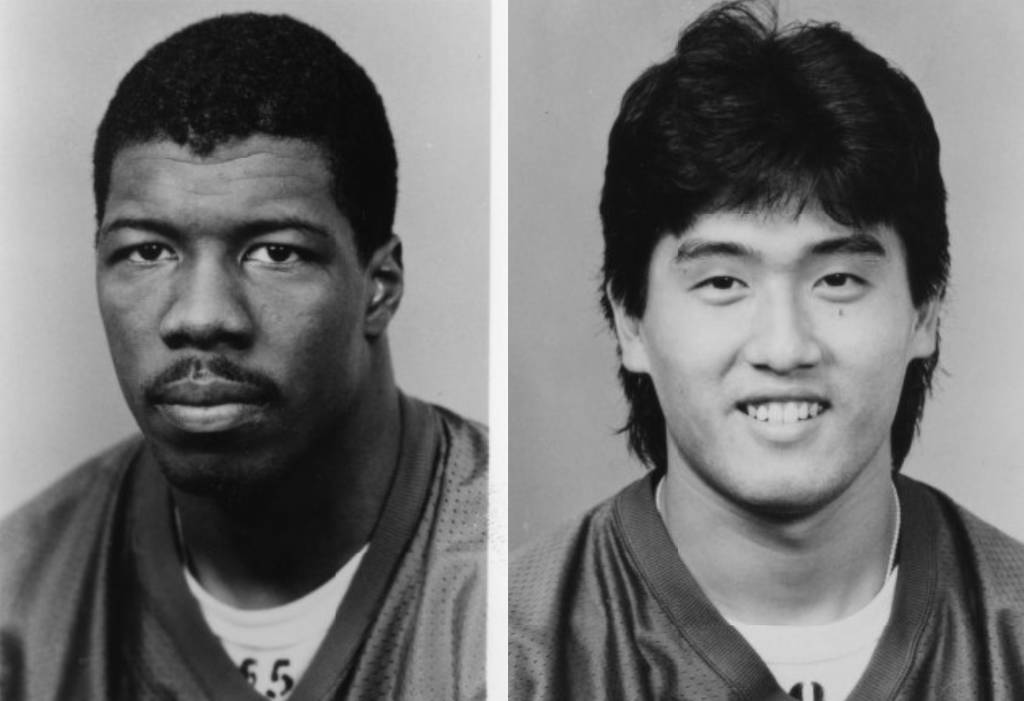
The Big Red selected Michigan LB Anthony Bell and UCLA kicker John Lee with their first two picks in the 1986 NFL Draft.

More concerning was the uncertainty about Curtis Greer, the Big Red’s best pass rusher. Greer, who had started every game but one in the previous four seasons and had led the team with seven sacks in ’85, had undergone surgery immediately after the season for a knee that had bothered him most of the year. There was no guarantee Greer would be ready to go when the ’86 season started. (In fact, after having some cleanup surgery during training camp, he missed the entire season).  

Continue reading

Big Red Draft History: 1985 NFL Draft

When Luis Sharpe signed a free-agent contract with the Memphis Showboats of the United States Football League two weeks before the 1985 NFL Draft, the Cardinals suddenly had a big hole to fill.

A first-round draft pick in 1982, Sharpe had started at left tackle all 41 games in his first three seasons with the Big Red, but now it looked like he had been lost to the upstart USFL. The Cardinals hoped to find his replacement in the Draft.

Trouble was, four of the best tackles were snatched up before it was the Cardinals’ turn to pick in the first round—Lomas Brown (Lions), Ken Ruettgers (Packers), Kevin Allen (Eagles) and Jim Lachey (Chargers)—so the team went to Plan B and selected Mississippi defensive end Freddie Joe Nunn with the 18th overall choice.

A few months earlier, Big Red coach Jim Hanifan and his staff had coached the North team in the Senior Bowl, and Nunn’s performance for the South squad had impressed Hanifan.

“He roared in on us all day long from defensive right end,” Hanifan recalled. “It’s going to be a pleasure having him on the same side of the fence. … He can create havoc for us as a pass rusher right away.”

To mitigate the loss of Sharpe, St. Louis picked Wisconsin’s Scott Bergold in the second round. Bergold had been a defensive tackle in college but Hanifan, who had coached Bergold in the Senior Bowl, said Bergold would be converted to offensive tackle in the NFL. Although that plan didn’t work out, Sharpe re-signed with the Cardinals before the 1985 season and played another 10 years with the team.  

Continue reading

Big Red Draft History: 1984 NFL Draft

The Big Red Zone continues its series looking back on each of the 28 St. Louis Cardinals drafts (1960-87). This installment focuses on the 1984 Draft, which was held May 1-2 in New York.

When the Cardinals selected University of Tennessee wide receiver Clyde Duncan with their first-round pick (17th overall) in the 1984 NFL Draft, no one was more surprised than Duncan himself.

“It was a really a shock. I had no idea I would go in the first round,” said Duncan, who did not make a significant impact as a receiver at Tennessee until his senior season, when he caught 33 passes for 640 yards and six touchdowns.

The Big Red chose Duncan even though they could have taken the more highly rated Louis Lipps, a wide receiver from Southern Mississippi. 

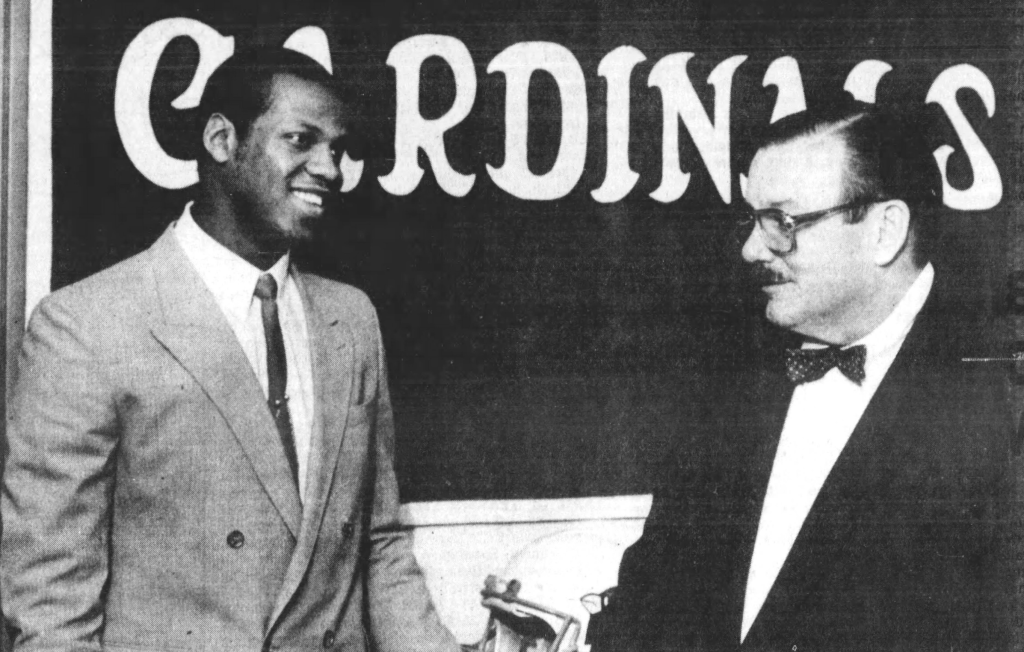
Cardinals owner Bill Bidwill (R) greets 1984 top pick Clyde Duncan.

In his first two seasons in the NFL—his only seasons—Duncan had a combined four receptions for 39 yards and one touchdown. In his first two seasons, Lipps caught 104 passes for 1,994 yards and 21 TDs for Pittsburgh.

There was only one problem with Duncan. He couldn’t catch the football. 

Continue reading

Big Red Draft History: 1983 NFL Draft

The Big Red Zone continues its series by looking back on each of the 28 St. Louis Cardinals drafts (1960-87). This installment focuses on the 1983 Draft, which was held April 26-27 in New York.

The Cardinals went into the 1983 NFL Draft with some uncertainty about their secondary.

Roger Wehrli had retired after the 1982 season, bringing to an end a 14-year Hall of Fame career. Carl Allen had bolted from the Cardinals and signed with the USFL. And Jeff Griffin was still recovering from a broken arm he suffered during the final game of the ’82 season, a 41-16 playoff loss to Green Bay.

Leonard Smith was the Cardinals first round pick in the 1983 NFL Draft

Who was going to start at left cornerback opposite Wayne Smith?

In an effort to answer that question, the Big Red loaded up on defensive backs in the draft, targeting the cornerback position in the first, second, fourth and sixth rounds. 

With their first-round pick (17th overall), the Cardinals took McNeese State’s Leonard Smith, who many scouts had rated as the second-best cornerback in the draft after Tim Lewis (picked 11th overall by Green Bay) despite having played at Division I-AA McNeese State in the Southland Conference.  

Continue reading

Big Red Draft History: 1982 NFL Draft

It’s rare when a football team finds two offensive tackles in the same draft who not only start immediately as rookies but become longtime pillars of the line. 

That was the case in 1982, when the Cardinals drafted UCLA’s Luis Sharpe in the first round (16th overall) and East Carolina’s Tootie Robbins in the fourth round (90th).

The Big Red traded down five spots in Round 1 and made Sharpe their first offensive lineman taken in the first round in 20 years (Irv Goode, 1962). An All-American and a three-year starter in college, the 6-5, 275-pound Sharpe was voted UCLA’s most valuable player in 1981. Jim Hanifan, who had been an NFL offensive line coach before being named head coach of the Cardinals in 1980, recognized Sharpe’s potential from Day 1.

Continue reading

Big Red Draft History: 1981 NFL Draft

The Big Red Zone continues its series by looking back on each of the 28 St. Louis Cardinals drafts (1960-87). This installment focuses on the 1981 Draft, which was held April 28-29 in New York.

Hugh Green or E.J. Junior? That was the question staring the Cardinals in the face as they debated who to select with the fifth overall pick in the 1981 draft.

Green, a 6-2, 225-pound defensive end from Pittsburgh, had been one of the best college players in 1980. A three-time All-American, he had won the Lombardi Trophy as the nation’s best lineman and had finished second in the Heisman Trophy balloting.

Junior, a 6-3, 238-pound end from Alabama who had played for legendary coach Bear Bryant on two national championship teams in 1978 and 1979, also had been a consensus All-American in 1980.

In the end, the deciding factor was size. And Junior was the choice.

Continue reading

Big Red Draft History: 1980 NFL Draft

The Big Red Zone continues its series looking back on each of the 28 St. Louis Cardinals drafts (1960-87). This installment focuses on the 1980 Draft, which was held April 29-30 in New York.

Was that the sound of “Hail to the Victors” coming from the Cardinals’ draft room on April 29, 1980? It could have been the University of Michigan fight song, given that the Big Red took a pair of Michigan players with their first two selections in the NFL Draft.

With their first-round pick (sixth overall), they chose defensive end Curtis Greer, who had 48 tackles for 234 yards in losses during his college career. In the second round, St. Louis took tight end Doug Marsh, who caught 57 passes for 947 yards and 10 touchdowns for the Wolverines.

After the Cardinals recorded 28 sacks in 1979 (25th among the 28 NFL teams), their need for a pass rusher opposite Bob Pollard was obvious. And after struggling to find a dominant, pass-catching tight during the previous two seasons, Marsh seemed like he could fill the bill.

Continue reading