Jim Hart: The Early Years

This is the second in a five-part series of stories remembering Jim Hart, the Cardinals’ all-time passing leader.

The odds were stacked against Jim Hart when he arrived at the Cardinals’ training camp in Lake Forest, IL., in the summer of 1966. Not only was he an undrafted rookie, but he also was last in a line of six quarterbacks.

Sixth-year veteran Charley Johnson was the incumbent starter, and Buddy Humphrey was the backup. Behind them, but ahead of Hart, were Terry Nofsinger, rookie Gary Snook and Jack Ankerson.
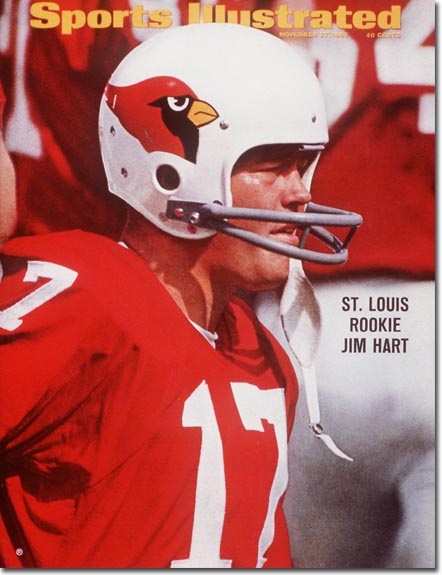
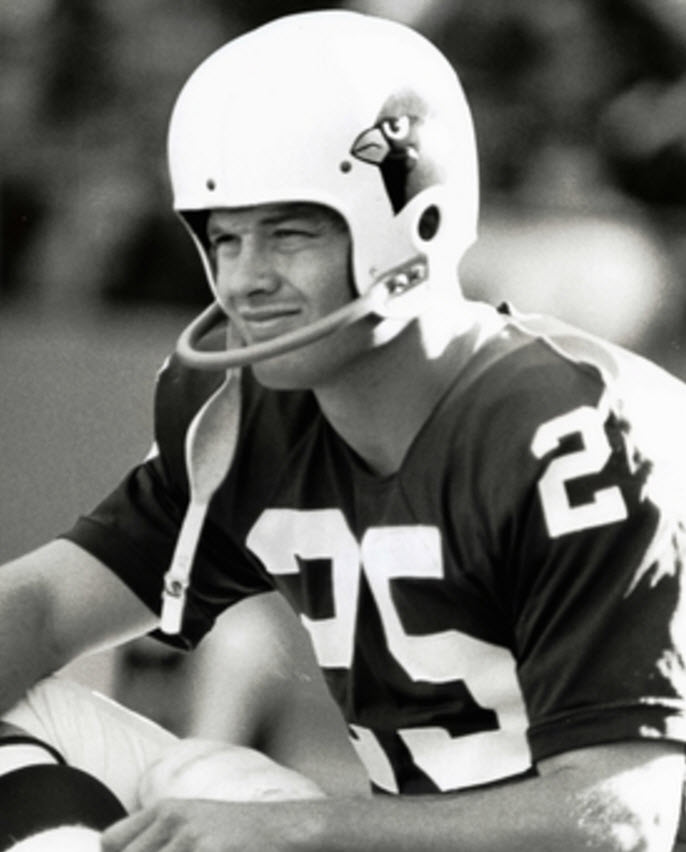
Jim Hart on the cover of Sports Illustrated in 1967

But a series of serendipitous events moved Hart up in the pecking order. Humphrey was released during camp; Snook, a fourth-round draft pick, was drafted by the Army and never played in the NFL; and Ankerson was moved to tight end and, later, cut. That made Hart the No. 3 QB.

Hart spent the first nine games of the ’66 season on the Cardinals’ taxi squad, meaning he practiced during the week but was inactive on game days. After Johnson suffered a season-ending knee injury in an early November game against the New York Giants, making Nofsinger the starter, Hart was activated for the final five games. His only playing time came in the fourth quarter of the season finale against the Cleveland Browns, where he completed four of 11 passes for 29 yards.

“The only positive thing there was that I got in a vested year toward my pension,” Hart said.

Continue reading
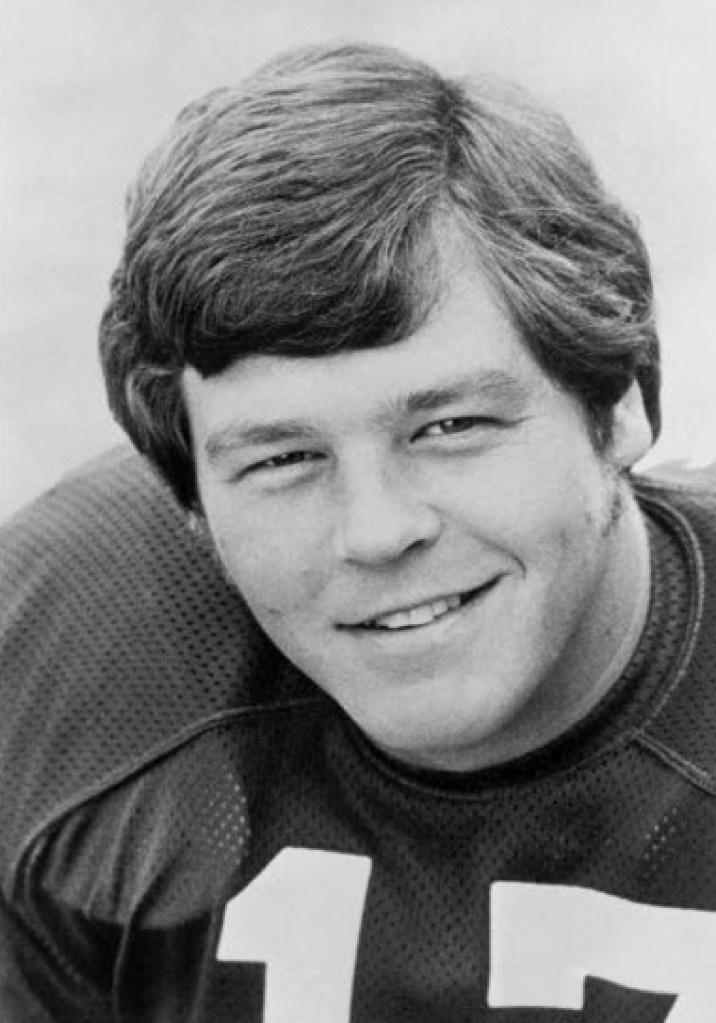
Cards Legend Jim Hart: A Statistical Review

(Editor’s Note: This is the first in a five-part series of stories remembering Jim Hart, the Cardinals’ all-time passing leader.)

Jim Hart

Whether Jim Hart belongs in the Pro Football Hall of Fame is a matter of opinion. Whether he was one of the best non-drafted quarterbacks to play in the NFL is a matter of fact.

The numbers confirm it.

In March 2017, the website footballoutsiders.com released a statistical study comparing the 36 undrafted quarterbacks who had thrown at least 500 passes during their NFL careers. The top-level included Hall of Famer Warren Moon, Dave Krieg, Jon Kitna, Tony Romo, and Kurt Warner.

(There have been some additions in the last five years, but no one has moved up enough to significantly alter the list).

Hart’s career numbers put him near the top in most categories:

Continue reading

Big Red Legends: John David Crow

There was no better all-purpose running back in the late 1950s/early ’60s than the Cardinals’ John David Crow. The 6-foot-2-inch, 220-pounder was strong, had quick feet, great balance, was an excellent receiver, fantastic blocker, and may have been the best passer on the team for a couple of seasons.

“He’s big and strong and tough,” Chicago Cardinals head coach Frank “Pop” Ivy told the Chicago Tribune about his star running back in 1959. “I’ll tell you, he’s what we call a wiggler. It’s an almost indefinable quality. When the opposing defense is tight, he’ll bull his way into a hole, then suddenly wiggle through for extra yardage.”

John David Crow

Legendary football coach Paul “Bear” Bryant once called John David Crow “the finest player” he ever coached. Crow won the Heisman Trophy while playing for Bryant at Texas A&M in 1957. Later that year the Chicago Cardinals selected him as the second overall pick in the 1958 NFL Draft.

The rookie scored his first career touchdown when he recovered a fumble in the endzone against the New York Giants in the 1958 season opener. The following week he dashed for an 83-yard touchdown on the first play of the game and later added another score in a 37-10 win over Washington.

“He used that wiggle I was talking about,” Ivy explained after the game. “After he got into the secondary, he had no blocking at all. He was strictly on his own. He wiggled past a couple of defensive backs, and then simply outran everybody to the goal line.”

Crow scored a 91-yard touchdown a week later and was well on his way to rookie of the year honors, but a knee injury would slow him down and limit him to only 8 games his freshman season.

Continue reading

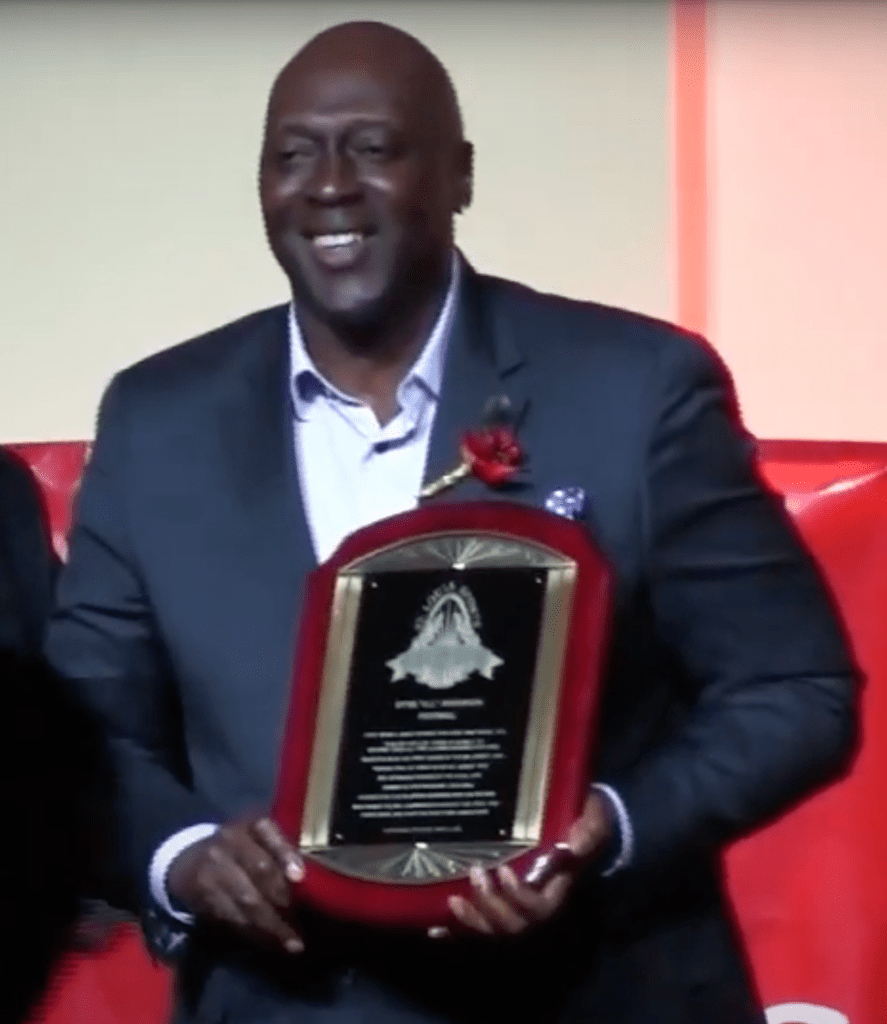
OJ Anderson inducted into the St. Louis Sports Hall of Fame

Former Big Red running back Ottis Jerome “OJ” Anderson was inducted into the St. Louis Sports Hall of Fame on May 2, 2022, at the Liuna Event Center in St. Louis. OJ becomes the twenty-first member of the St. Louis Football Cardinals to be enshrined.

OJ starred at the University of Miami and was the Cards top pick in 1979. The Florida native made a big splash in his NFL debut with a 193 yard performance against the Dallas Cowboys. He would set league rookie records for rushing yards (1,605), rushing attempts (331), and the most 100 yard rushing games in a season with 9. He was named first team NFL All-Pro, consensus NFL Rookie of the Year, NFC Player of the Year, and team MVP. Anderson became the first running back to twice rush for 100 yards against the Dallas Cowboys.

OJ became the Cardinals’ all-time leading rusher in 1981 when he broke fellow St. Louis Sports Hall of Famer Jim Otis’ record of 3,863 yards.

Continue reading

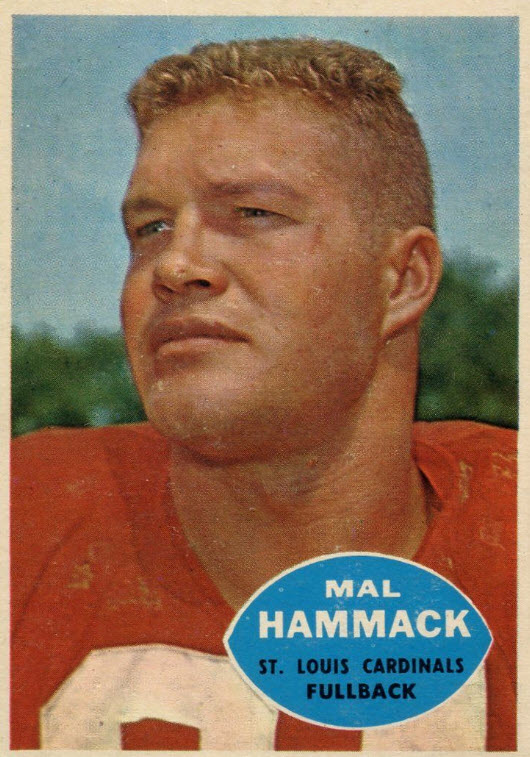
Forgotten Big Red Stars: Mal Hammack

Many remember hard-hitting Big Red special teamers like “Dr. Doom” John Barefield and Ron Wolfley, but a long forgotten “wedge-buster” from the 1960s was Mal Hammack.

Malcolm “Mal” Hammack started his career with the Chicago Cardinals in 1955. The Roscoe, Texas native played college ball at the University of Florida where he was second team all-SEC fullback. Chicago drafted him in the third round and wanted him to play linebacker, however, his weight of 200 pounds was on the light side, even in 1955.

Hammack was used sparingly at linebacker his rookie season and was soon moved to fullback where he would play most of his career. But he earned his mark on special teams. Hammack was a fierce competitor, loved contact, and was known for his body-jolting blocking and tackling. He was the lead Kamikaze and captain of the special teams.

“I like to go down on punts with a chance to kill the ball close in or maybe jolt the ball out of a receiver’s hands,” Hammack told Bob Broeg of the St. Louis Post Dispatch in a 1966 interview, “but I believe the most satisfaction is in peeling back to help block for a punt return, hopeful that it might go all the way. The most satisfaction, that is, next to winning.”

Continue reading

How Erich Barnes outfoxed Jackie Smith, Cardinals

Erich Barnes was a formidable foe of the St. Louis football Cardinals. He was an intimidating, savvy defensive back who played 14 seasons in the NFL.…

How Erich Barnes outfoxed Jackie Smith, Cardinals

SI VAULT: TWO FLAGS FOR THE CARDINALS?

(Excerpt from the November 09, 1964 Edition of Sports Illustrated)

Written by Edwin Shrake

PENNANTS HAVE NOT RECENTLY FLOWN OVER THE CITY OF ST. LOUIS. THIS YEAR THE BASEBALL CARDINALS BROUGHT ONE HOME, AND THE FOOTBALL CARDINALS MAY BRING ANOTHER FROM THE SCRAMBLE OF THE NFL EASTERN DIVISION.

John David Crow

In St. Louis last week a bunch of guys with sledgehammers were knocking down an old burlesque house to clear ground for a new stadium, which means that by the spring of 1966 night baseball and Sunday afternoon football will have replaced sex in at least one area of the leafy and pleasant town on the banks of the Mississippi River. For the citizens of St. Louis, who sat 18 years in the gloom of Busch Stadium waiting for their baseball Cardinals to win another World Series, the new stadium is a merit badge for patience. A further reward may be granted to St. Louis fans before the first graffito is scratched into the concrete of the new stadium. The football Cardinals leaped off to a flourishing 3-0-1 record in the NFL’s Eastern Division.

Continue reading

Forgotten Big Red Stars: Wayne Morris

There may have been no player more respected in the Big Red locker room than Wayne Lee Morris. The six-foot-200 pound running back was a quiet, unassuming leader who did whatever the coaches asked of him.

The Cardinals selected Morris in the 5th round of the 1976 NFL draft out of Southern Methodist University. But the team was already stacked at running back with Pro Bowlers Terry Metcalf and Jim Otis as well as solid backups Steve Jones and Jerry Latin. Morris was hardly guaranteed a roster spot.

Wayne Morris

“In high school they had me starting on the varsity as a sophomore,” he told Tom Barnidge of the St. Louis Post Dispatch after the draft. “In college, I joined the varsity as a freshman. Now I’m trying to join it again. I hope this is one more stepping-stone.”

Morris was well-known in Dallas. He rushed for 3623 yards in three seasons at South Oak Cliff High School and was named an All-American in three different publications.

At SMU, he was the nation’s top freshman rusher with 884 yards and went on to set the school’s career rushing record. He ran for 154 yards in his first varsity game against Wake Forest and racked up 202 yards against Texas his senior season.

Morris knew that he would once again have to prove himself in the NFL.

Continue reading

Forgotten Big Red Stars: Luke Owens

Former St. Louis Cardinals defensive lineman Luke Owens grew up in Cleveland and wanted nothing more than to beat his boyhood favorites. However, the Big Red were winless in ten games against the Browns since Luke had joined the team in 1958.

Luke Owens led the Cardinals in sacks from 1960-1964.

“You’ve got to live around those guys most of the year the way I do to appreciate the chest-puffing, back slapping adulation they get,” Luke told the St. Louis Post Dispatch in 1963. “I get tired of it. We’ve tied ’em a couple of times, but never beat ’em. I’d like to blow ’em right into the lake (Erie).”

But on November 17, 1963, Big Luke finally saw his longtime dream come true when the Cardinals defeated the Browns 20-14 at Municipal Stadium.

“It’s like Christmas for me,” Owens said in the locker room as his teammates presented him the game ball.

Owens was a star two-way player at Kent State University and was selected in the third round by the Baltimore Colts in the 1957 NFL draft. He played in eleven games at defensive tackle his rookie season, but was released by the Colts at the end of the year.

Continue reading

Big Red Legends: Jim Bakken

The record has stood the test of time. And it might just stand for the rest of time.

When Jim Bakken retired from the St. Louis Cardinals in 1979, after 17 seasons in the NFL, he was the franchise’s all-time scoring leader with 1,380 points.

Forty-four years later, that hasn’t changed. Bakken still holds that record—and he may never let go of it. Of the 49 players below him on the team scoring list, most are retired or playing for another team. The only exceptions are 37-year-old kicker Matt Prater (42nd with 137 points) and quarterback Kyler Murray (tied for 47th with 120 points).

“I guess I didn’t really think about that,” Bakken says when asked if he ever imagined his record would last this long. Actually, he takes more pride in a single-game NFL record he set.

On September 24, 1967, a windy day at Pitt Stadium in Pittsburgh, Bakken kicked seven field goals (18, 24, 33, 29, 24, 32 and 23 yards) in a 28-14 victory over the Steelers. (He attempted two more field goals into the wind that missed their mark.)

Continue reading