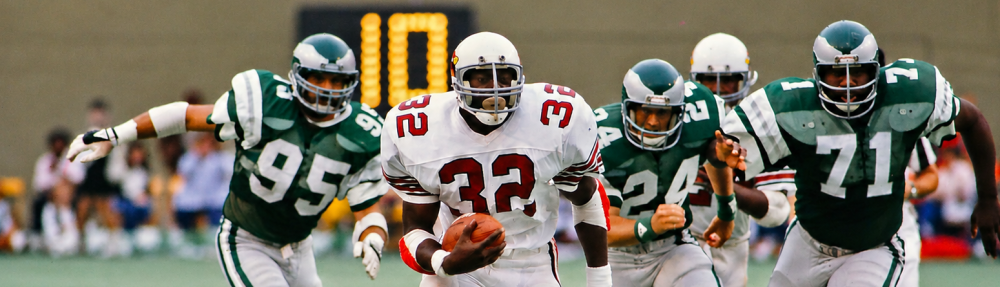
Few players in professional football carried the nickname “The Golden Palomino” with as much flair as Donny Anderson. A versatile running back with blazing speed, a knack for catching passes, and a reputation for toughness, Anderson enjoyed a distinguished career in both college and professional football. Although he is often most closely associated with the Green Bay Packers, Anderson’s later years with the St. Louis Cardinals demonstrated his leadership and adaptability as a veteran player.
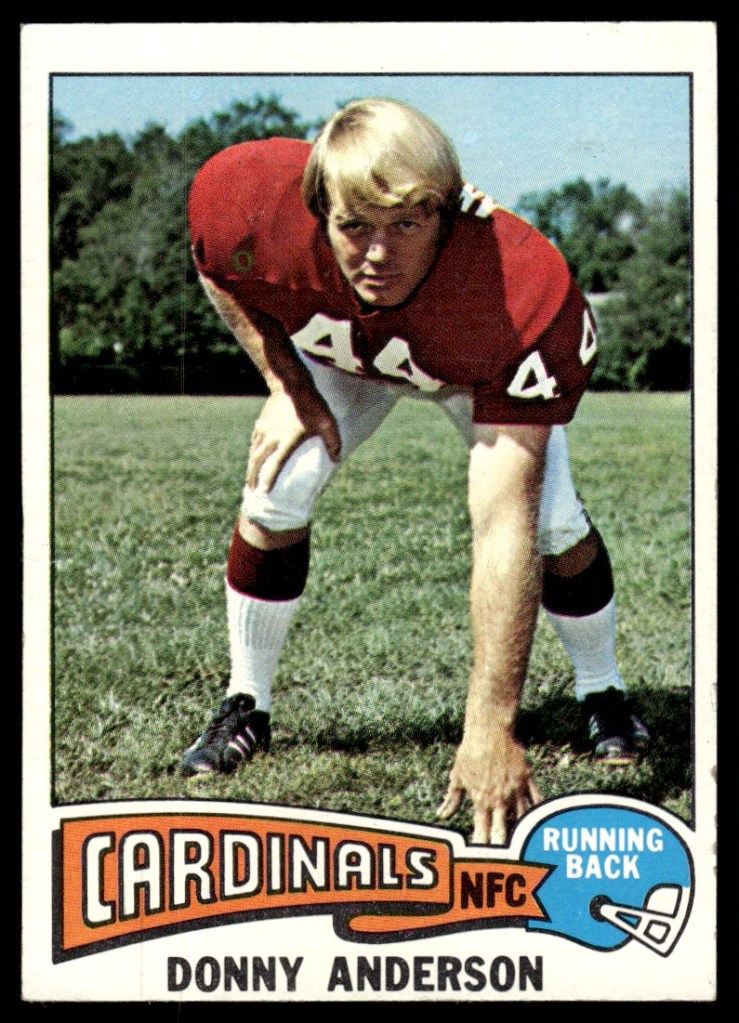
Born on May 16, 1943, in Borger, Texas, Anderson grew up in a football-rich environment and quickly became known for his athletic ability. He starred at Stinnett High School before attending Texas Tech University, where he became one of the most electrifying players in college football.
At Texas Tech, Anderson excelled as a runner, receiver, punter, and kick returner. His all-around ability made him one of the nation’s most dynamic offensive weapons during the early 1960s. He received All-American honors twice (1964 and 1965) and was a three-time all-Southwest Conference halfback (1963–65). Anderson held many of Texas Tech’s football records and finished fourth in the 1965 Heisman Trophy race. He is a member of the Texas Tech Hall of Fame.
Anderson entered professional football with enormous expectations. In 1965, he signed a historic contract with Green Bay after being selected in the first round of the NFL Draft. There were reports that he turned down almost $900,000 from the AFL Houston Oilers before signing with the Pack.
“I want to play the best and right now I think the best is in the National League,” Anderson said after signing a reported six-year, $650,000 contract. “This may not be true in five years or 10, but I’m going to play right now and I want to play the best. Money wasn’t the main factor.”
Head coach Vince Lombardi viewed Anderson as a perfect fit for the Packers’ evolving offense. Fellow All-American Jim Grabowski, a fullback from Illinois, was the Packers’ first pick in the 1966 NFL draft, and ninth overall. The duo was tabbed the “Gold Dust Twins” and were the projected successors of Paul Hornung and Jim Taylor, future Hall of Famers, in their final seasons with Green Bay.
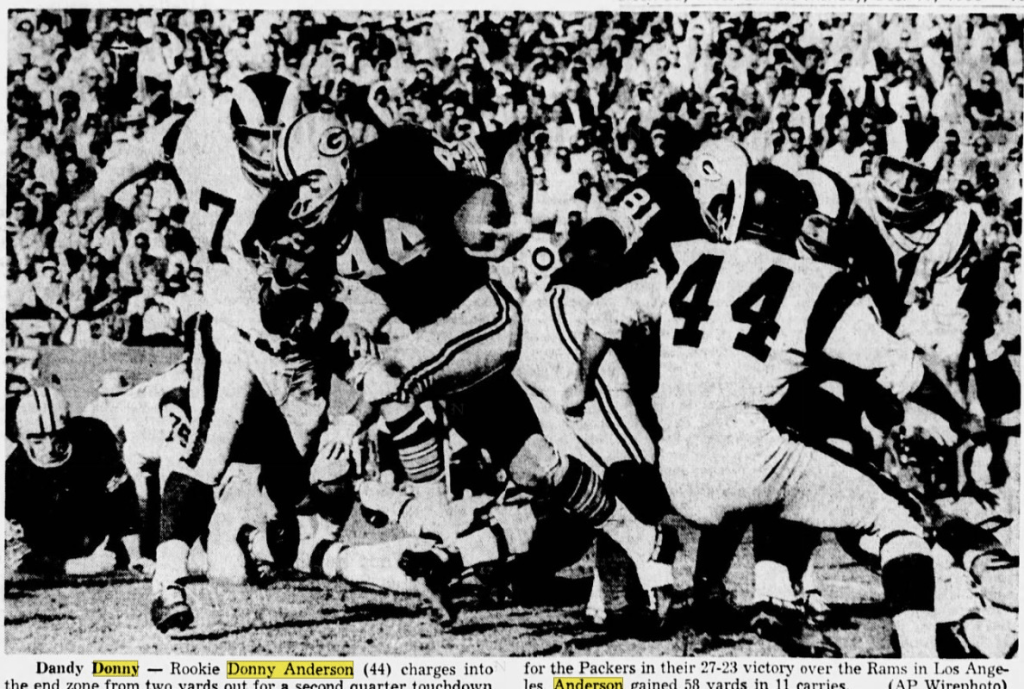
During his years with the Packers, Anderson contributed to victories in Super Bowls I and II. He proved especially valuable as a receiver out of the backfield, helping modernize the running back position at a time when most backs were primarily runners. Anderson’s ability to catch passes and create mismatches against defenders foreshadowed the role of future multi-purpose backs in the NFL. He also became known for his reliability in big games and his willingness to play through injuries.
ST. LOUIS BOUND
By the early 1970s, however, Anderson’s career entered a new chapter. The Packers traded him to the St. Louis Cardinals for fellow running back MacArthur Lane in 1972, giving the Cardinals a veteran playmaker with championship experience.
“I pretty well figured I’d be leaving,” Anderson told Green Bay Gazette after the deal. “I don’t think Dan Devine cares for my services too much. If I’m not good enough to play for Dan Devine, then naturally I have to move on.”
The Cardinals of the early 1970s featured several talented players, including quarterback Jim Hart and wide receiver Mel Gray. Anderson complemented those players well because he could contribute in numerous ways without demanding attention. He was the only player the Cardinals ever had who had been on a Super Bowl champion, and he understood the intangibles necessary to reach the top.
“You need a close relationship among the players,” he told St. Louis Post-Dispatch columnist Jeff Meyers in 1972. “You must strive for protection in terms of building a working relationship with the coach. You form a winning combination from the top of the organization to the bottom, from the president to the man with the least amount of responsibility.”
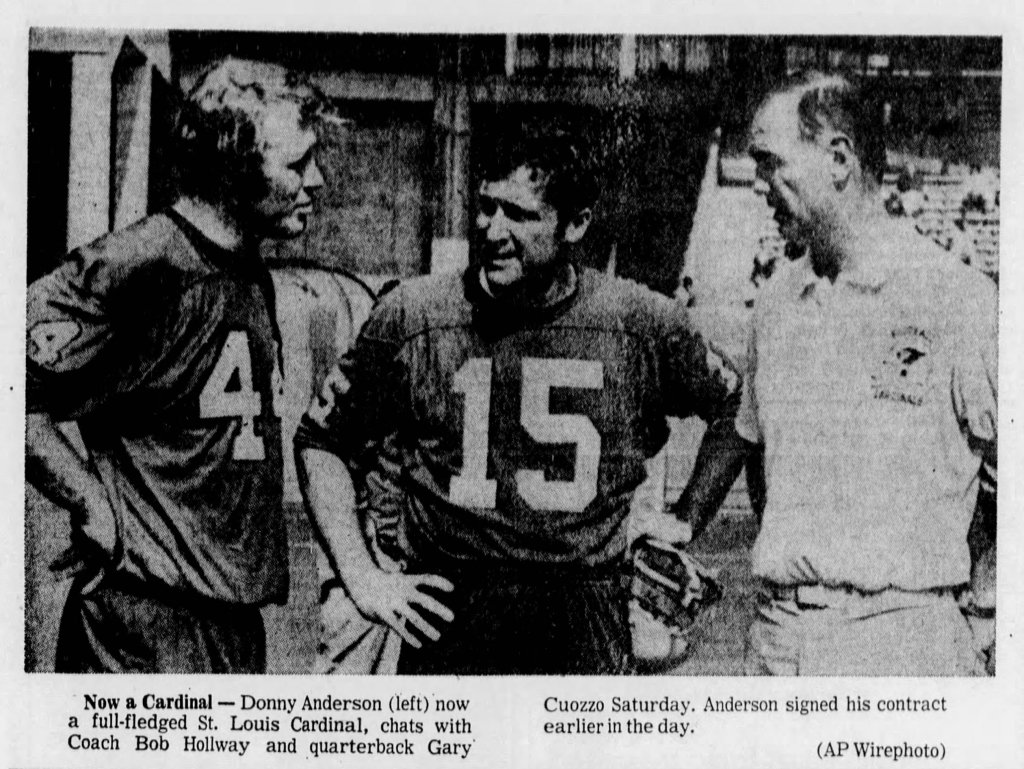
Anderson evolved from a flashy young star into a seasoned professional. Cardinals coaches used him in multiple roles, including running back, receiver, and even punter during his first season with the Big Red.
Anderson was the Cardinals’ top rusher his first two seasons and had his most productive year in 1973, when he totaled 1,088 all-purpose yards and scored 13 touchdowns. The Cardinals struggled to achieve sustained success in the standings, but Anderson consistently delivered dependable performances.
Although injuries began to take a toll as Anderson aged, he continued to compete with determination. He scored six touchdowns in 1974 in a limited role behind Terry Metcalf and Jim Otis. He wasn’t surprised when he was traded to the Miami Dolphins after the season.
“Last year was the first time in my career I had to work to make the team,” the 32-year-old told the St. Louis Post-Dispatch. “I read the handwriting on the wall. Let’s face facts. This will be my tenth year in the NFL. I’ve lost a little speed, but I felt I could make it up in other ways. Any time you’ve played this length of time, you never want to sit on the sidelines.”
Miami head coach Don Shula said he viewed Anderson as a replacement for Jim Kiick, who had departed for the World Football League.
“Our main interest in Anderson is as a pass receiver coming out of the backfield,” Shula said after the trade. “We feel that he can play either halfback or fullback in passing situations.”
However, Anderson never played a regular-season game in Miami. Unsatisfied with his performance during training camp, the Golden Palomino hung up his cleats.
“It’s time to face realities,” Anderson said. “I didn’t think I could contribute as well as I thought I could when I came to camp. I suppose I could hang on, but I like to be a front-runner. It would be disappointing to me if I was put into a situation where I had to perform and I didn’t do it. When you’re finished, you’re finished.”
“When you get older, you don’t heal as fast as you used to,” he said. “I don’t want to be 50 and crippled, unable to play golf or go fishing.”
Anderson finished his NFL career with more than 4,000 rushing yards, nearly 3,000 receiving yards, and scored 55 touchdowns. Those numbers only tell part of the story. Anderson played during an era when offenses were far less pass-oriented and opportunities for multipurpose backs were more limited than they are today.
After retiring, Anderson moved to the Dallas area and competed on celebrity golf tours for almost 20 years. In 1996, he wrote a book called Winners for Life to teach teens the importance of setting goals to achieve their dreams. Soon after, Anderson launched the Winners for Life Foundation that helps send at-risk kids to college. Anderson was inducted into the Green Bay Packers Hall of Fame in 1983 and is a member of the Texas Tech Hall of Fame and the College Football Hall of Fame in 1989.


I always liked and respected the quarterbacks, running backs, receivers, linemen, linebackers and defensive backs who doubled as punters or placekickers in the NFL in those days.
LikeLiked by 1 person
Thanks, Mark. Many coaches liked those types of players as well. It really helped them with managing rosters. You might be interested to know that Donny Anderson’s grandson is Sawyer Anderson. He is a record-setting QB from the Dallas area and currently a freshman at the University of Arizona!
LikeLiked by 1 person
After all these years he still ranks 9th in total yards from scrimmage for Texas Tech. There is so much you could say about Donny Anderson. Not only a very good, dependable and versatile football player, but very intelligent as an individual as well. He really wasn’t in it for the money. Took pride in his ability to contribute to the team and knew when it was time to call it a career. Considering how conservative offenses were in that era Donny Anderson was ahead of his time. I liked the information about Donny Anderson being the only player on the Big Red who had previously been to a Super Bowl. Also what Anderson had to say about what it takes for an organization to get to the Super Bowl. I bet the other Cardinals players enjoyed what he had to say. Not so sure about management and the owner!
LikeLiked by 1 person
Thanks for your comment Phillip. There were a lot of expectations on Donny and fellow rookie John Brockington, two bonus babies whose combined contracts totaled over a million bucks. An enormous amount of money back then. While Donny was a very good running back, he helped revolutionize the punting game. His punts weren’t as long as the league leaders but he and Lombardi basically invented “hang time.” For example in 1967, Anderson’s hang time strategy resulted in opponents returning only 13 of his punts for a total of 22 yards all season.
LikeLike