In its entry for Arlington, MA, a town six miles northwest of Boston, Wikipedia lists 59 names under the “notable people” heading. Eleven of the 59 have ties to sports, including: John A. “Johnny” Kelley, winner of the 1935 and 1945 Boston Marathons; Tom McNeeley Jr., a former heavyweight boxing contender who challenged Floyd Patterson for the heavyweight title in 1961; and Tom Yewcic, a former quarterback for the Boston Patriots, a former catcher for the Detroit Tigers, and the only person ever to play two professional sports at Fenway Park.
Wiki’s entry for Picher, OK., a town tucked into the northeast corner of Oklahoma which once was a major national center of lead and zinc but is now a ghost town, identifies only one “notable person:” Joe Ron Looney, the lead guitarist for the country music band Rascal Flatts.
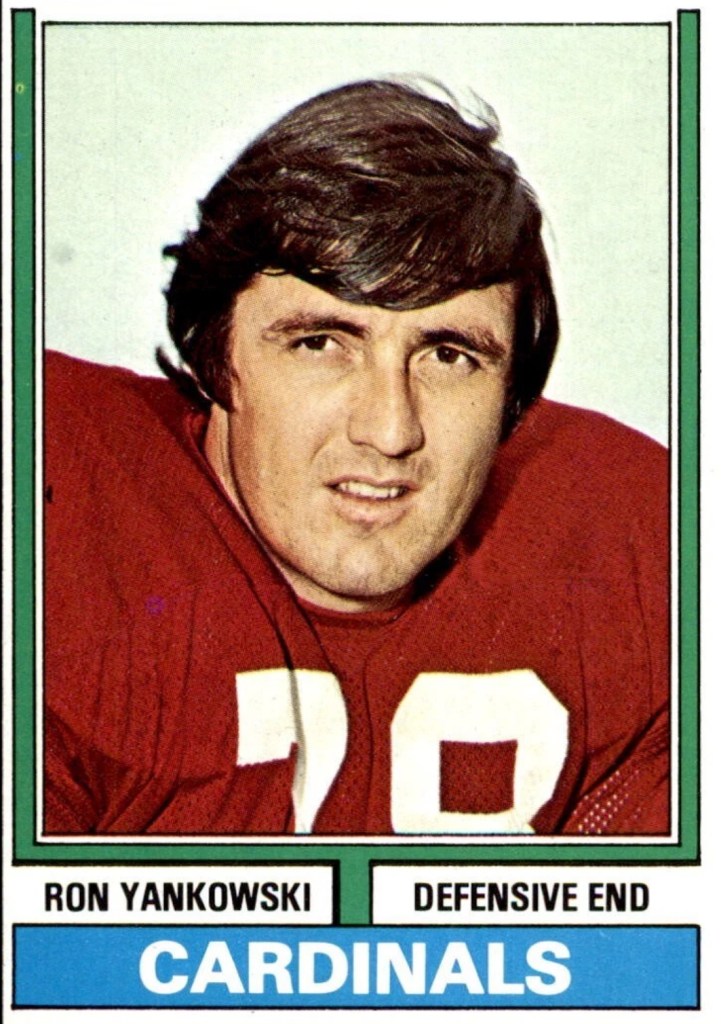
Neither entry mentions Ron Yankowski, who was born in Arlington; spent his formative years growing up on a farm in Picher; played football for a junior college national champion as well as Kansas State before forging a 10-year career in the NFL as a defensive lineman with the Cardinals.
Yankowski hardly had time to make a name for himself in Arlington—his family moved to Picher when he was just six months old—but to do all he did in football and not be recognized as a notable person from Picher? Let’s just say Yank fell through the Wikicracks.
“I think I was left out of a lot of stuff,” Yankowski said without a trace of bitterness. “It didn’t bother me because I’ve enjoyed life. To come from a small town and go where I went was kind of unbelievable. I really thank God for watching over me.”
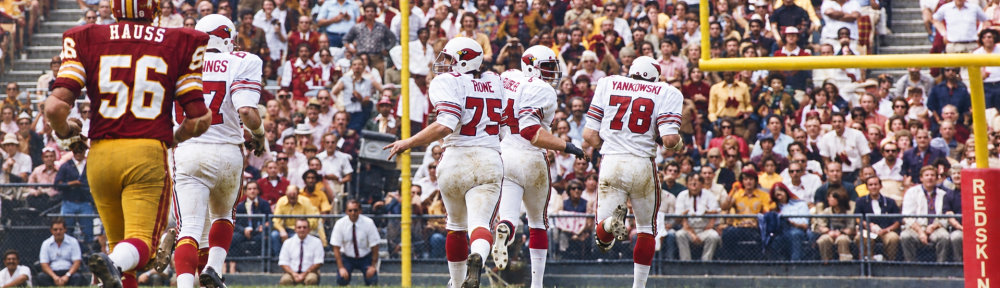
Today is the 52nd anniversary of Yankowski’s shiniest moment in the NFL. On this date (September 22) in 1974, he returned a fumble 71 yards for a touchdown in a game against the Washington Redskins. It gave the Big Red a 7-3 lead in a game they would win, 17-10, in a season which they would go 10-4, win the NFC East Division, and qualify for the NFL postseason for the first time since 1947, when they still were the Chicago Cardinals.
On the final play of the first quarter, the Cardinals blitzed Redskins quarterback Billy Kilmer. Linebacker Pete Barnes hit Kilmer, dislodging the ball which bounced off the ground and into Yankowski’s hands. Without hesitation and with teammates Council Rudolph and Bob Rowe providing some escort, Yankowski “took it to the house” as they say for the only TD of his pro career.
“It was exciting,” Yankowski recalled. “I had never done that before. It made me happy, it made my teammates happy, and the main thing is we won the game.
“The one thing I heard later on was that someone had written that it looked like I ran with a refrigerator on my back.”
The 6-foot-5, 250-pound Yankowski was so winded when he crossed the goal line that teammate Terry Miller suggested he go to the sideline and get some oxygen.
Immediately after the Cardinals kicked off to Washington following Yankowski’s TD, they had to call a timeout because Yank was still on the bench, getting oxygen.
“I kind of got chewed out (by linebacker Larry Stallings) for that,” Yankowski said.
Time hasn’t diluted Yankowski’s memory of the touchdown, the only one of his NFL career. He still thinks about it, and not just on every September 22nd. “It was exciting for me, (but) I don’t go out and have a beer or anything like that.”
Although Yankowski never made a Pro Bowl or an All-Pro team, he was a steady, you-could count-on-him player who made big plays throughout his 10 years with the Big Red. He played in 128 games, making 87 starts, recovered five fumbles and had 30 sacks—five in both 1974 and 1980, his final season, and four in two other seasons. Yankowski’s versatility allowed the Cardinals to play him at multiple positions on the D-line, including both ends and both tackles one game.
The only major injury Yankowski suffered during a pileup in a 1976 game; his hand was still on the ground when teammate John Zook swung his leg around and accidentally kicked his arm. “I went over to Dr. (Fred) Reynolds and said, ‘I think I broke my arm,’ ” Yankowski said. And he said, ‘You let me decide whether it’s broke or not.” It was broken and Yankowski missed the final nine games that season.
Yankowski started 10 games as a rookie in 1971 and was a regular starter 1973-75 and in ’77 In 1978, when Bud Wilkinson became the Big Red’s head coach, the team switched from a 4-3 defense to a 3-4 (only three linemen) and Yankowski was the odd starter out. Althoughhe didn’t start a game in ’78 or ’79, Yankowski still got a lot of playing time (in ’79, he had four sacks). When Jim Hanifan took over as head coach in 1980, he restored Yankowski to the starting lineup.
Yankowski’s contract with St. Louis expired after the 1980 season and the team let him go. When no other team showed interest in signing him, “I thought, well, maybe my time is up.
“People have asked me how did I last so long in the NFL. I think the main reasons were I worked hard, I (studied) the game, and I practiced against one of the best offensive tackles there was, and that was Dan Dierdorf. When you can practice against the best and do good there, you’re going to make it,” he said.
Yankowski’s road to the NFL was hardly straight and narrow. Picher was a small town of about 300 people, and only 19 players came out for the high school football team one year Yankowski played both defensive end and center. He also played basketball and ran the mile in track.
After high school, Yankowski didn’t receive any offers to play football in college. Instead, he joined the Army Reserves and tried his luck as a boxer. He won his first match but lost the next two, the last one in a Golden Gloves bout. “I was kind of rough around the edges. Didn’t have any speed to my hands.”
Picher’s former quarterback, who was a year behind Yankowski, played football at Northeastern Oklahoma A&M, a junior college in Miami, OK., five miles from Pricher. He suggested that might be a place for Yankowski. NEO’s defensive line coach came and watched Yankowski’s final boxing event. Afterward, he offered Yankowski books and tuition to come try out for football and a full scholarship if he made the team. In 1967, Yankowski’s first of two seasons at NEO, the Golden Norsemen were the National Junior College Athletic Association’s champions and Yankowski earned NJCAA All-American honors.
After two years at NEO, some people thought Yankowski might try to transfer to the University of Oklahoma. Instead, he chose Kansas State. “It’s not that I didn’t like OU. I wanted to play. I didn’t want to be on the fourth string.” During his two seasons at K-State, he batted down 15 passes. As a senior, he was selected to the All-Big Eight Conference team.
Yankowski was interested in playing in the NFL, but didn’t know if that interest would be reciprocated. Shortly before the 1971 NFL Draft, the Cleveland Browns called and said they were thinking about drafting him. But he never heard from them again. After his name wasn’t called on the first day of the draft, the Cardinals took him in the first round (eighth round overall) on the second day.
You couldn’t make up a story like Yankowski’s story: growing up on a farm in Picher where he learned to drive farm equipment when he became a teen; trying his hand at boxing; playing for a national JUCO championship team; finally making it at a major college; then getting drafted and playing 10 years in the NFL.
Now that’s a notable narrative, Wikipedia be damned.


You never get tired of looking at the video clip of Ron Yankowski’s fumble return against the hated Redskins. It made me remember that in the other game we had against Washington that year I believe that the first TD for the Big Red came on a Roger Weherli interception. The Don Coryell Cardiac Cardinals were never considered great defensive teams but in 1974 the defense was actually pretty good.
LikeLike
Glad you noted that Pete Barnes made the crunching hit on Billy Kilmer that jarred the ball loose and gave Ron Yankowski his big moment. Barnes often gets overlooked by others in the retelling of the story,
An intriguing note about Pete Barnes: He was the Cardinals’ 1974 team chess champion.
LikeLike