The football Cardinals left St. Louis almost 40 years ago, but the memories they forged during their 28-season stay in the LOU live on in the minds and hearts of their fans.
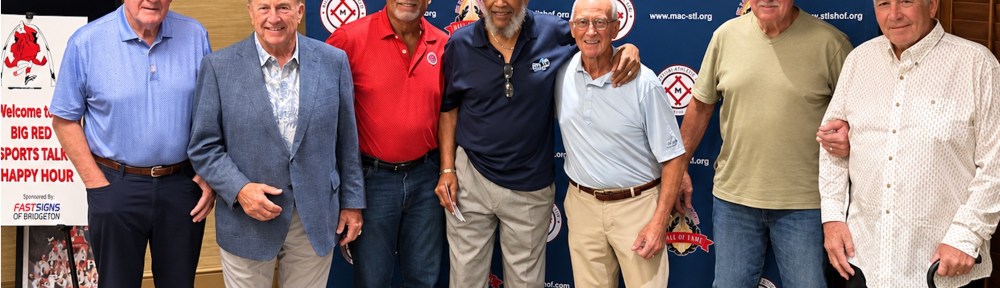
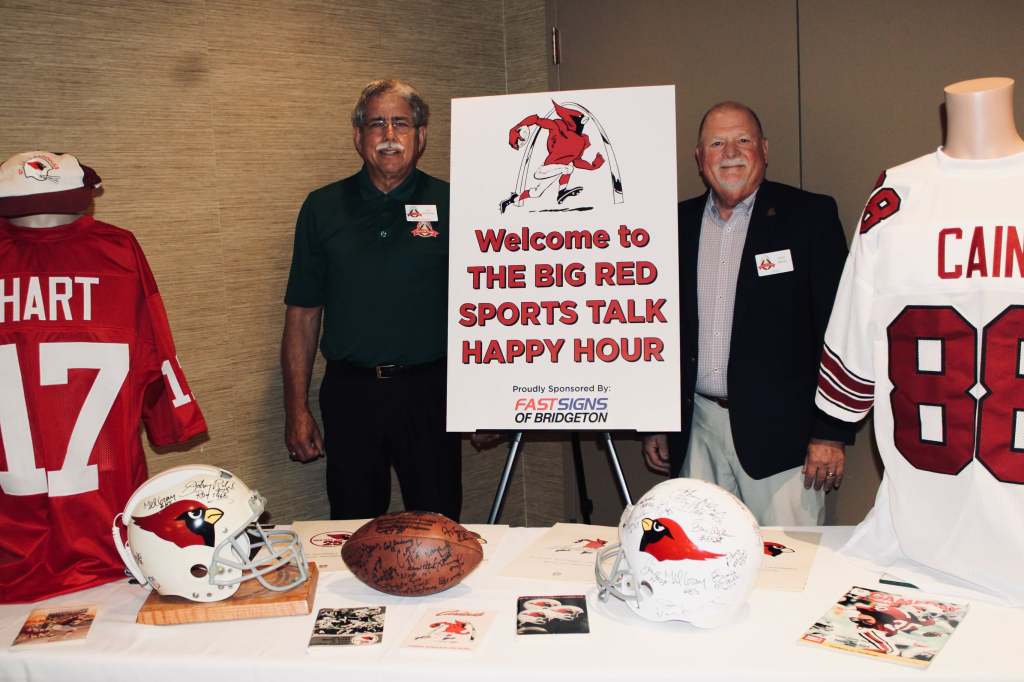
That was evident recently when dozens of enthusiastic Big Red devotees filled a room at the Missouri Athletic Club West and listened raptly as a quartet of former Cardinals players stoked those memories with their rich stories.
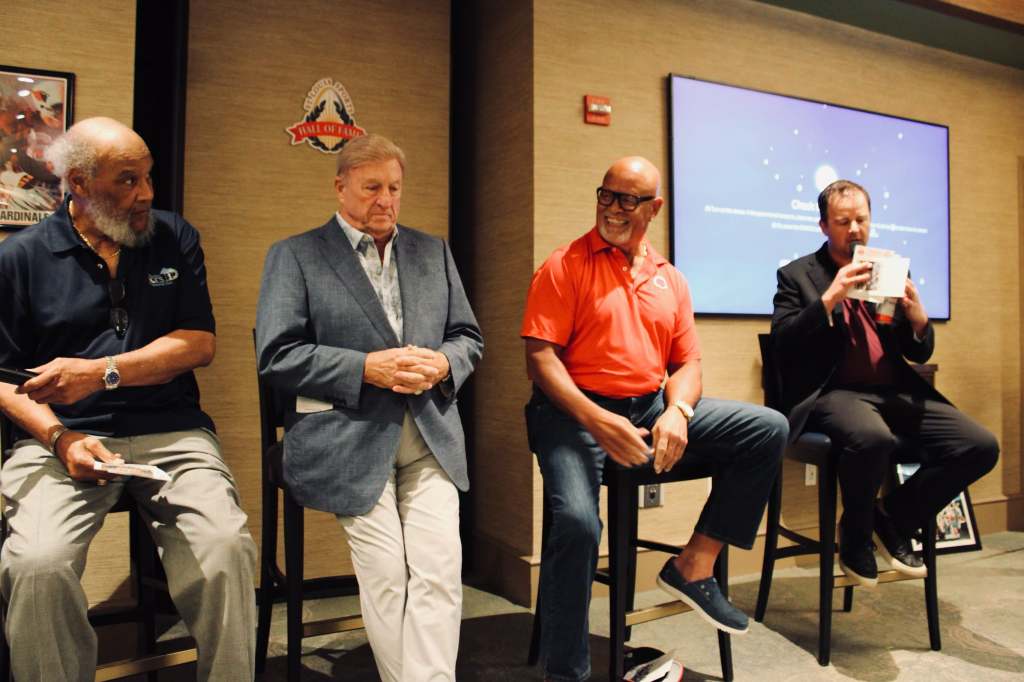
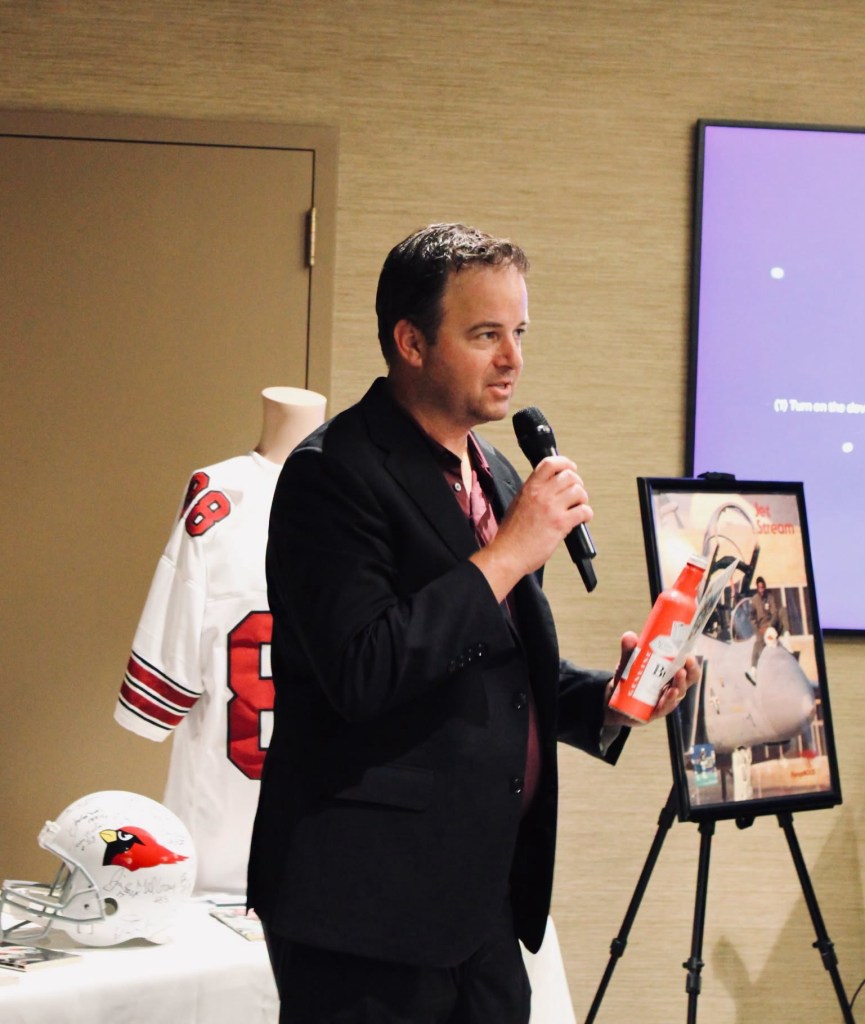
The event, “Big Red Sports Talk Happy Hour,” was presented by the St. Louis Sports Hall of Fame in collaboration with the MAC. KMOX Radio personality Tom Ackerman was the moderator.
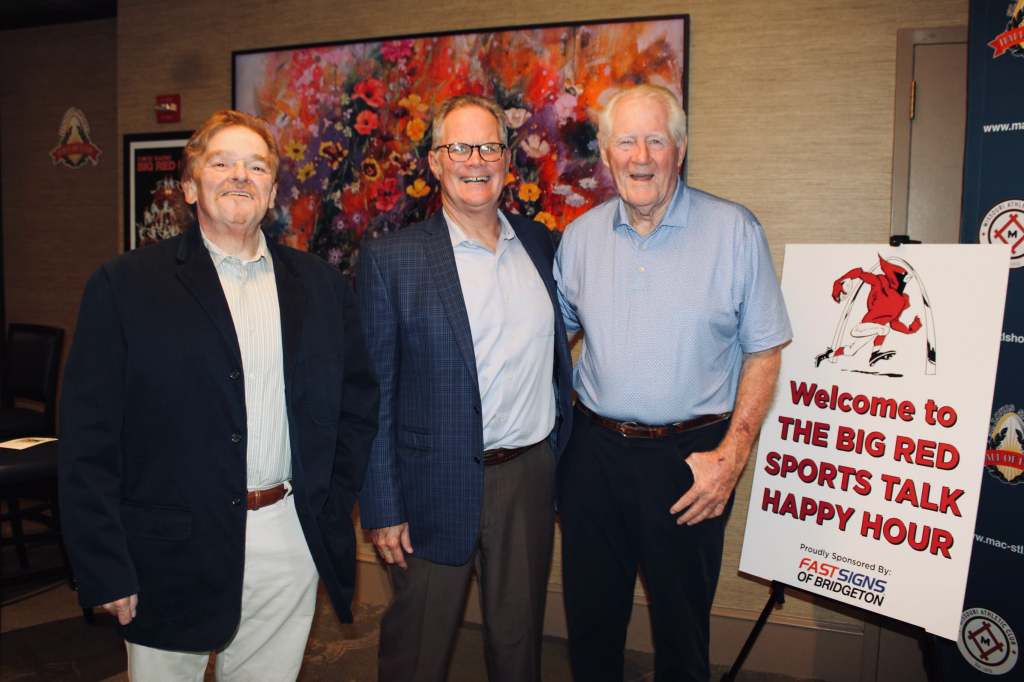
The panel consisted of Pro Football Hall of Fame tight end Jackie Smith, running back Johnny Roland, fullback Jim Otis and linebacker Eric Williams. Three other former Big Red players—defensive tackle Bob Rowe, defensive end Ron Yankowski and kicker Mike Wood—also were in attendance.
For the fans, it was an opportunity to see the players in a relaxed setting off the field. For the players, it was an opportunity to show their personalities and tell some stories.
The first topic was about how each player started his football career. Williams, a native of Kansas City, said Missouri and Southern Cal were two of the colleges that recruited him out of high school.
“Missouri offered me KFC while USC (served) the biggest steak I’d ever seen,” Williams said. “Where do you think I would go? Coming from Kansas City, (USC) was my biggest dream.”
Smith started out at Kentwood (LA) High School as a clarinet player in the school band. Myriad injuries limited him to only five games in football, but he was able to run track and field, where he participated in the mile relay, the quarter mile and the hurdles. He was a state champion in the hurdles as a senior.
Northwestern Louisiana offered Smith a half scholarship in track and field and a full scholarship if he would agree to also play football. He didn’t get much of a chance to show his skills in the school’s run-heavy offense. Playing in the NFL wasn’t in his plans, so imagine his reaction when the Cardinals selected him in the 10th round of the 1963 NFL Draft.
“It was a big-ass surprise to me,” he said, drawing laughter from the crowd. Smith played 15 seasons with the Big Red, retiring after the 1977 season. Early in the 1978 season, Dallas coach Tom Landry phoned Smith and asked if he would be interested in playing for the Cowboys.
“I thought it was a joke, so I hung up on him,” said Smith who did join the ’78 Cowboys and earned and appeared in his only Super Bowl.
Otis, who has never been shy about proclaiming his allegiance to Ohio State University, where he played fullback for Woody Hayes and was a consensus All-American selection after his senior season in 1968. He drew laughter when he said, “I didn’t know I was going to Ohio State until I was about four.”
Otis, who played the last six seasons of his nine-year NFL career with the Big Red and finished fourth in the league in rushing yards (1,076) in 1975 (as a fullback) added that he thinks the current OSU team’s running backs could get more yards if they didn’t line up so deep in the backfield. In fact, he called Buckeyes linebackers coach James Laurinitis and offered to come to Columbus and talk to the running backs and their position coach about how it should be done.
“That was a few weeks ago,” Otis said. “I haven’t heard back yet.”
One person in the audience asked the players which opponent hit them the hardest on the football field.
“I was ‘Dirty Nasty Big Red,’ Williams said, reminding everyone about his nickname. “Nobody gave me a hardest hit.” But he did recall a game in Philadelphia during his second season (1978) when he collided with Eagles running back Wilbert Montgomery on a screen pass. “My helmet turned one way and his turned the other way. My left eye was twitching. I woke up at halftime asking where I was at.”
Smith said, “If they hit you as hard as they could, you may not remember it anyway. I got hit so hard in a game one time that I didn’t wake up until I was riding on the bus to the airport.”
During the 90-minute discussion, the players commented on several other topics.
Williams on getting drafted: A friend pranked him with a phone call, saying he was Cardinals personnel director George Boone and the Cardinals were going to draft him in the third round. Williams became so suspect that when the real George Boone called Williams to tell him he had been drafted in the eighth round, “I cussed him out.”
Smith on Don Coryell, the architect of the Cardiac Cardinals in the mid-1970s who was wound tighter than a steel cable when he was on the football field: “I thought he was nuts. But a nice kind of nuts. Sometimes when he talked to us, he would get so worked up he started crying.”
Otis on playing behind the dominating offensive line of tackles Dan Dierdorf and Roger Finnie, guards Conrad Dobler and Bob Young and center Tom Banks: “They were competitive. They would argue in the huddle. ‘I can get my guy.’ Those (opponents) across the way knew they had been attacked.”
Roland on his Big Red teammates: “We had a quarterback (Jim Hart) who could sling it,” running back Johnny Roland said. “Jim and I came to the Cardinals the same year (1966) as rookies. We had some pretty good players and teams. There were a lot of great guys.”
Williams on Big Red tight end J.V. Cain, who tragically collapsed on the field during training camp in 1979 and died of a heart condition: “I made the team by going against him every day (in practice). He taught me so much he made it easy for me.” The two men became such close friends, Williams said, “I named my son after him (James Victor Williams).”
Their team may be long gone, but Big Red fans will never forget the players. Perhaps Williams said it best about the relationship.
“I’ve been out of football for almost 40 years and people still want to talk to me,” he said. “That speaks for itself.”


I enjoyed all the insights and the photos, too. Thanks for posting this.
LikeLiked by 1 person
It was a great evening. The players really appreciate these types of events. And so do the fans.
LikeLike
Sounds like it was a great way to spend an evening. I know that I really would have enjoyed being there. Born and raised in St.Louis the football Cardinals became a big part of my life as a kid during the 70’s. I still enjoy watching old Big Red clips on the internet. They will always have a place on my heart.
LikeLike