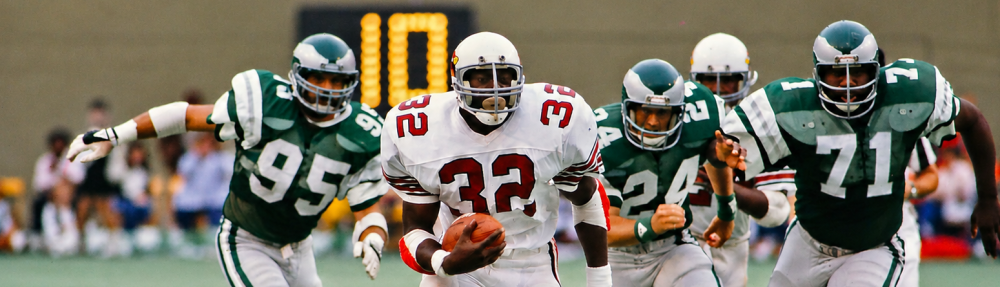
Throughout the 1970s, the Cardinals’ defensive front saw plenty of change—but one steady presence anchored it all: Ron Yankowski.
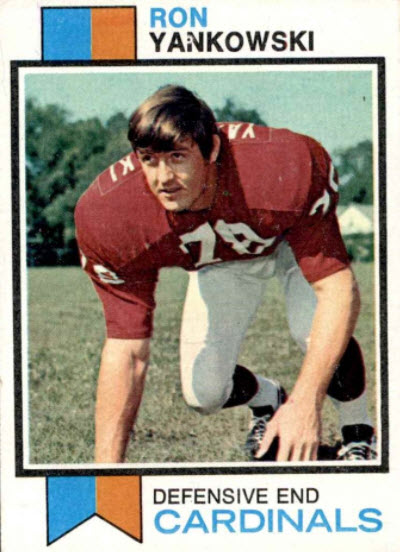
“Yank” started 87 games while capably handling both tackle and end duties. Though he spent much of his career outside the spotlight, he quietly delivered consistent, dependable play year after year.
“I’m used to my status,” he said in a St. Louis Post-Dispatch story in 1979. “I never have been one for saying a lot. I don’t need the recognition.”
“My first seven years, I was a starter. Then, all of a sudden, I was a backup. I had to stop and think for a minute. I had to recognize what they wanted me to do to help the team. Then, I tried to do it the best I could.”
“I wanted to be satisfied with myself each week when I picked up my paycheck.”
OKLAHOMA BOY
Yankowski was a well-rounded athlete, but hardly a headline star at Picher High School, tucked along the Oklahoma–Kansas border just 30 miles southwest of Joplin, Missouri. At 6-foot-1 and 190 pounds, many believed he was undersized for a college defensive tackle. Scholarship offers never came, and with football’s future uncertain, Yankowski enlisted in the Army reserves—putting the game on hold for the time being.
“One day I was at work after getting out of the Army,” he recalled in a 1969 story in the Kansas City Times, “and Coach Jack Wallace called me from Northeast Oklahoma (Miami) Junior College (about 10 miles from Picher) and asked if I would like to play football. He offered me a half of a scholarship.”
Yankowski was a member of the NEO Junior College National Championship team in 1967 and was named NJCAA All-American in 1968. He had dreams of playing at the University of Oklahoma after junior college, but they never called. Instead, it was another Big Eight school that got his attention.
“Kansas State sent me one letter when I was a freshman, but that was the only letter I got from anyone. Then, when I was a sophomore, I started getting more letters and had more contacts with K-State. I was invited to visit the campus and when I did, I liked what I saw and decided I wanted to go play at Kansas State.”
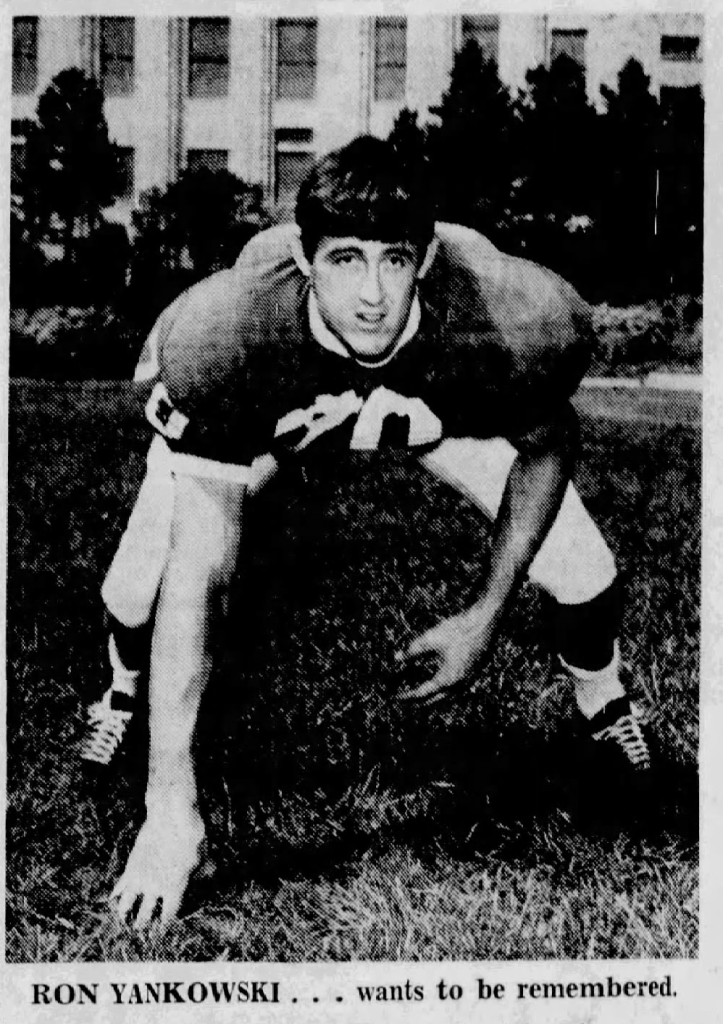
He batted down 15 passes in two seasons at K-State and was named first team All-Big Eight Conference his senior year.
“He’s the quietest guy off the field you’ll ever meet,” K-State defensive coach Jerry Elliott said in a 1969 story in the Wichita Eagle. “But he’s about the most aggressive football player I’ve ever seen.”
ST. LOUIS BOUND
The Cardinals selected Yankowski in the 8th round of the 1971 NFL Draft. At 230 pounds, few gave him a chance to make the team, and the farm boy from Oklahoma had doubts himself.
“I saw how many defensive linemen they had and thought to myself, ‘I don’t have a chance.'”
He disregarded any suggestions that his weight made him vulnerable on the defensive line.
“I can handle big men. In college, I played against guys who were 265 pounds. I was only 215. I’m as strong as they are, but I rely on quickness.”
“If someone gets a lick on me, the next time I’m gonna give him twice as much…that’s the way I feel. I just hate to get beat.”
Not only did Yankowski earn a roster spot, but he became one of the Cardinals’ biggest surprises of 1971. The rugged rookie quickly worked his way into the starting lineup and continued to impress as the season went on.
Yankowski proved remarkably durable, missing just one start over the next three seasons while steadily elevating his game each year.
Perhaps the most memorable moment of his NFL career came in 1974 at RFK Stadium when he scooped up a Billy Kilmer fumble and rumbled 71 yards for a touchdown in a 17-10 victory over the Washington Redskins.
“I saw the ball flopping on the grass,” said the defensive end, “and I thought to myself, ‘Better fall on it.’ But then I saw a white jersey out of the corner of my eye, so I picked up the ball and started running and hoped to get a block.”
“I thought someone would catch me, but when I looked back, I saw nothing but white jerseys, and when I got to the end zone, I looked back for a flag.”
He had five quarterback sacks in 1974, which ranked second on the team.

Yankowski’s first major setback came in 1976, when he sustained a compound fracture of his right arm during a 33–14 victory over the Philadelphia Eagles.
“I got my arm stuck between two guys’ legs on the ground—it was just sticking up in the air. It was like my arm was in a vise. Then, another guy fell right on it. I knew what was going on and I knew it was pretty bad. I felt it when it broke. I could see that it was crooked.”
“I sat in the dressing room and thanked God that it wasn’t worse. It could have been a leg or knee.”
Yankowski went through nine weeks of football inactivity and an offseason of rehabilitation.
“Last year was like sitting through hell,” he said in an August 1977 story in the St. Louis Post-Dispatch. “I couldn’t do anything. I was in a cast. I was squirming and jumping around like any other fan. The thing was I’d see something happen, I’d know I could stop it, but I wasn’t able to play.”
Yankowski returned strong in 1977, reclaiming his starting role and leading the team with five sacks. Though he lost his starting spot over the next two seasons, he remained a dependable presence, appearing in every game as a key reserve.
He accepted the change with characteristic humility.
“When I first got drafted,” he said, “all I wanted to do was make the team. Then, I hoped to stay around long enough to qualify for the pension. Now, I’m thinking about 10 years and then playing it by ear. I enjoy the game more now than ever. Each year, each game is a completely different experience.”
In 1980, Yankowski was at home chopping firewood when he learned the Cardinals had selected five defensive linemen in the draft, including No. 1 choice Curtis Greer.
So, the Oklahoma boy hit the weights and arrived at training camp with renewed vigor.
“This is the best I’ve seen him look,” new head coach Jim Hanifan said.
But did Yankowski really believe he could keep Greer on the bench?
“Sure I do,” he said. “I know he’s probably a little quicker and a little stronger, but I get the feeling right now I’m the man for the job.”
Yank had one of his best training camps in 1980, but just before the season opener, he received a phone call from Larry Wilson and was summoned to Busch Stadium.
“I was just hoping for a trade, because I knew I wasn’t going to be here,” he said. “Then I figured a trade was out and that I had just been cut. The same things kept going over and over in my head.”
Yankowski was told it came down to numbers and the Big Red were going with the younger linemen.
“The overall decision was made to get rid of me, and I have to accept it and go on from there.”
But a week later, Yankowski received another call from Wilson.
“I called him and said, ‘You ready to go back to work?'” said Wilson. “He was happy.”
Greer had suffered a concussion during the season opener against the Giants and the Cardinals once again needed ole reliable.
“They give you those garbage bags to put your stuff in when they release you, and when I got home, I just threw the bag in the corner,” Yankowski said. “It was there, just like I’d left it, when I got the call to come back.”
“It’s good to have Yank back,” said Wilson. “He’s an excellent guy and a darn good football player. He knows our system and he will be able to step right in. He’s an exceptional person and a hard worker. He was having his best training camp. We just had those young guys and had to make a move.”
Yankowski started 13 games in 1980 and made an immediate impact, recording two sacks in his first start against Detroit. At 34, he turned in one of his finest seasons, finishing with five sacks and a fumble recovery—a performance that even caught him by surprise.
“If anyone had told me that after 13 games I’d be leading the team in sacks, I’d have called him a liar. I can play another year, maybe two,” he said. “Each year you do it, you enjoy it more. It’s easier for me now. I know what to do in camp. I may have lost a step in speed, but I get smarter every year.”
Before the 1981 season, Yankowski requested a partial contract guarantee, hoping to avoid enduring another grueling training camp only to be released, as had happened the year before. The Cardinals declined his request and parted ways with the 10-year veteran. The 35-year-old decided to call it a career.
Ron Yankowski’s career never made headlines, but it defined what it meant to be a true professional. For a decade, the quiet kid from Picher, Oklahoma, outworked and outlasted expectations, carving out a place on a line that saw constant change. He wasn’t flashy or loud—just reliable, tough, and respected by every man who lined up beside him. In a sport that often measures greatness in numbers, Yankowski’s legacy rests in something more profound: consistency, humility, and heart. For the Cardinals of the 1970s, he was the steady force that never quit, and for those who knew him, that’s what they’ll remember most.


To not only play 10 years in the NFL but to also have spent all those years with an Organization like the football Cardinals means that you did something right. Impressive the way Ron Yankowski came back in 1980.
LikeLike
I think he could have kept playing after 1980, but probably not with the Cardinals. He had a business and young kids so he hung ’em up.
LikeLike
I enjoyed this story very much, Bob, and you did a masterful job of telling it. I truly admire how often Ron Yankowski overcame long odds to succeed in football.
To further appreciate the background Yankowski came from in attending Picher (Okla.) High School, your readers might like this information from the Oklahoma Historical Society about the town of Picher:
“Picher was the most productive mining field in the Tri-State Lead and Zinc District (Oklahoma, Kansas, and Missouri) and produced more than $20 billion in ore from 1917 to 1947. More than 50 percent of the lead and zinc metal consumed in World War I came from the Picher Field. During the mining boom years, more than 14,000 men worked in its mines, and another 4,000 worked in 1,500 mining service businesses. Many of these workers commuted to work using an extensive trolley car system that ran all the way to Carthage, Missouri.
“In 2000, Picher’s population stood at 1,640. (However), Picher no longer exists as a community. In spring 2008 an F4 tornado damaged many houses and killed six people. Due to the possibility of collapsing mine shafts, the Environmental Protection Agency (EPA) determined that the town was dangerous to inhabit. The EPA evacuated the town and in June 2009 completed a buyout of all residents, enabling them to relocate. In 2010 the U.S. Census counted a population of 20 within the boundaries of the former town of Picher. In early 2010 the demolition of houses and business buildings began, and in 2011 only one business house and six residences remained.”
LikeLiked by 1 person
Thanks for you comment, Mark. I had reach about the tornado in Picher during my research, but decided against mentioning it since it happened well after Ron lived there.
I work with a guy from Oklahoma who lost two homes to tornadoes. He decided to move his family to Ohio about 10 years ago.
LikeLike