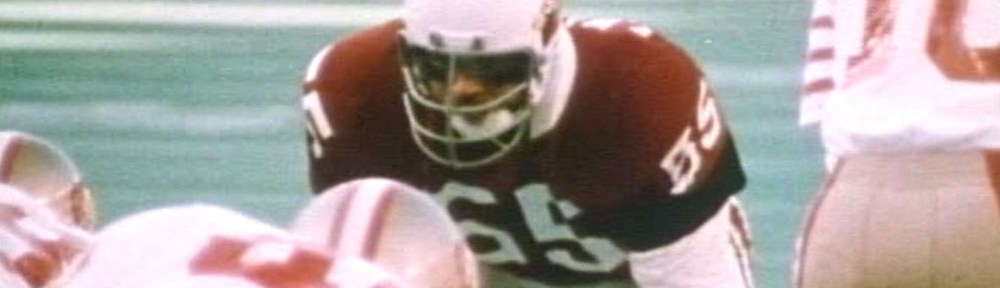
They called him ‘Dirty Red’—a name that stuck not just because of his hair, but because of the way he played: rough, relentless, and with zero apologies.
“I like any name that sounds violent,” Williams said in a St. Louis Post-Dispatch interview in 1978. Sometimes they call me ‘Filthy,’ sometimes ‘Red’ and sometimes ‘Dirty Red.’ Anything they call me is all right with me.”

If you’ve ever met Eric Williams, you’d learn that he is a soft-spoken, easygoing guy. But once he strapped on a helmet, he morphed into a relentless force—ferocious, focused, and utterly fearless.
“Off the field, I’m this happy-go-lucky guy that you’re talking to. On the field, I’m crazy. In the game, I’m ready for four quarters of violence. A linebacker has to destroy people. A linebacker has to put fear in people’s hearts—like Willie Lanier and Dick Butkus did. I pattern myself after them.”
Williams overcame many odds on his journey to the NFL. He lost his dad at a young age, overcame a heart murmur, and found a father figure in his high school football coach who kept him on the straight and narrow and never let him quit.
He was introduced to football at a Kansas City Boys Club as a young boy in the 1960s. However, his real training ground was the street. He battled kids who were older, tougher, and twice his size.
“That’s how I got my toughness. They kind of knocked me around a bit.”
It was at Kansas City Central High School, where Williams blossomed under the guidance of his head coach, Charlie Lee.
Lee moved Williams from running back to linebacker and ensured Williams was academically ready for college. Later, Lee advised the young football player against leaving USC after he didn’t see the field during his freshman year.
“My high school coach is everything to me,” Williams said of Charlie Lee. “I bet he’s sent 25 to 30 guys to colleges from an all-black high school. He was a father figure to us all. If we didn’t get good grades, we had to speak to Charlie Lee. You didn’t want an F. And he always told us how there was a better life out there.”
Williams earned All-City honors at Central and became one of the first graduates to earn an athletic scholarship.
CALIFORNIA BOUND
The 6-foot-2, 225-pounder had many college offers, including Missouri, but elected to play ball for legendary coach John McKay at the University of Southern California.
“I chose USC because of Kenny (former high school teammate Kenny Randle), O.J. Simpson, and USC’s great football tradition. There was something else, too. Every time I visited a school, I wanted to know how many pro scouts were watching the team. Well, Kenny wrote me from USC and said there were two or three on the field every day.”
Williams didn’t see the field much during his first three years while McKay was at the helm and almost quit after his freshman season.
“I didn’t get to play with the varsity at all as a freshman. I played three games as a sophomore before I was injured. Then, I mainly rode the bench as a junior,” he told the Los Angeles Times in 1976.

“Then McKay left before my senior year, and when the new coach (John Robinson) took over, he made me a starter. I was a team captain, I led the team in tackles, and I was voted the outstanding defensive player. People started asking me what happened. Where did the new Eric Williams come from? I told ‘em I wasn’t any different, I was just playing.”
“It’s hard to impress anybody if you don’t get to play.”
The Trojans finished the ’76 season with an 11-1 record and Williams made a key stop in their 14-6 Rose Bowl victory over Michigan.
The 1976 Trojans had 14 players selected in the NFL draft, including three linebackers. Williams credited his linebacker coach, Don Lindsay, for preparing him for his pro career.
“He’s the one that believed in me at USC. He taught me and coached me well when I got drafted by the St. Louis football Cardinals,” Williams said. “I had the skills. We were already covering backs out of the backfield. I knew how to handle linemen.”
RETURN TO THE SHOW-ME STATE
Williams was selected in the eighth round of the 1977 NFL draft by the Big Red.
“I was anxious for the draft, real anxious. I wanted to go higher, but I was just happy that anybody called by the time it was over. It was exciting, but really I wouldn’t want to go through it again.”
The Cardinals had a surplus of linebackers in training camp. Williams had a 50-50 chance to earn a roster spot. He discussed that during a 1977 interview with the St. Louis Post Dispatch.
“I try not to really think about it. I have as good a chance to make this team as anybody. I guess I have as good a chance to get cut, too, though.”

“We talk (fellow linebackers) about it at times. We ask each other how we think we’re doing. We’ll look for help or ask for advice. That’s one thing that surprised me about a pro camp. It’s not cutthroat like I thought it’d be. I figured it’d be every man for himself—you take care of you and I’ll take care of me.”
Williams played middle linebacker in USC’s 3-4 defense. This formation included three down linemen and four linebackers. However, the Cardinals played a 4-3. They planned to use Tim Kearney in the middle. So, Williams had to learn a new position on the outside.
“That’s been another adjustment for me. I never played anywhere but in the middle for Southern Cal. There are a lot of new things to learn. New reads on the blocking assignments, new keys to watch. You’ve got to be a little quicker on the outside, and you’ve got to get the assignments down so they come automatically. Once you get the learning part down—what you have to do—you can start concentrating on doing it.”
“I wanted to play football ever since I was a little kid. It’s not exactly like I thought it would be—it’s a job now—but I’m happy. I’m happy I’m where I am with the chance I have. I just hope I’m still here when the cuts are made.”
FIRST NFL START
Williams was one of four rookies to make the 1977 roster. He impressed on special teams and earned his first start at mid-season against the New York Giants on Monday Night Football.
“My first start,” Williams said after the defense recorded a shutout in the 28-0 victory. “They told me I was gonna start. You know I was excited. This was my chance, and I wanted to make the most of it. But the first thing I had to do was cool down. Had to collect myself.”
“I’d get in the locker room and I was so wound up I was worried I might psyche myself out before we ever kicked off.”
“The guys around my locker have been on my case pretty good. They’re always reminding me that I’m a rookie. They never let me forget it. But I didn’t feel like a rookie against the Giants. I haven’t felt like one in a long time.”
“It was just an exciting night all around. This was the first time I got introduced on the public address system, you know.”
Williams recorded four tackles and an assist in the victory. It was only the Cardinals’ second shutout since 1970.
“We’re not supposed to have any defense,” Williams said after the game. That’s what everybody’s been saying. But we showed the United States we have a defense. We had a good game plan. We were aggressive and we were fired up. But I can’t say too much. I’m only a rookie.”
Williams would start every game the rest of the season, including the Thanksgiving Day Massacre against the Dolphins. The 55-14 loss sent the Big Red into a tailspin.
“Something happened after that Miami game,” he said. “Everything collapsed. I’d never seen that happen before. Earlier in the season, we’d get on a team and after a while, you’d see that team just sort of quit. At the end of the year, well, we just collapsed.”
NEW COACH, NEW DEFENSE
The Cardinals fired Don Coryell in early 1978 and replaced him with Bud Wilkinson. The legendary University of Oklahoma head coach brought with him the 3-4 defense and Williams was moved back to his familiar inside linebacker position.
Williams added 10 pounds to his frame and was as confident as ever as he entered his second NFL season.
“Eric IS confident. No doubt about that,” Big Red defensive coordinator Tom Bettis told the St. Louis Post-Dispatch. “But there is something to what he says. He does have very good instincts. He has a good feel for the position. He’s quick, he’s aggressive and he’s a good tackler.”
“He makes a real concentrated effort to learn things,” Bettis added. “One thing about Eric, he’s always got a lot of questions to ask. He’s smart in the ways of football.”
“I compare myself with other people I watch on film and I think I’m as good as any of them,” Williams said. “Everybody talks about how good Bill Bergey is. Well, it’s my opinion that Bergey isn’t any better than me.”
“In college, I was overlooked in the draft. Last year, I was one of only two rookies starting at linebacker, but I was overlooked on the All-Rookie team. What I want most is to be respected by other players. Like Willie Lanier was respected. Like Dick Butkus was respected. When I’m on the field now, if people don’t know I’m good, I go over and tell them.”
Williams dislocated his shoulder in the season opening loss to the Chicago Bears and didn’t return to the starting lineup until October.
“My arm was just dangling there by my side,” he said. “I couldn’t practice. I couldn’t even run. I just sat on the sidelines for two hours and that kind of gets boring. The only thing I learned was all kinds of new positions to sit in. And to be truthful, I was scared. My arm was taking an awful long time to heal.”
The Cardinals lost all six games that Williams missed as a starter. While he worried about when or if he would ever return, a curious, somewhat selfish question occurred to him.
“I wondered if we would have lost all those games if I’d been playing. I don’t mean to sound cocky, but I’m a good linebacker. I’d like to know how much better the team has been with me back in there for the last five games.”
The Cardinals would win six of their last ten games with Williams in the lineup and everyone was looking forward to the ’79 season after their strong finish.
TRAGEDY AT LINDENWOOD
The Big Red had a strong draft in 1979, adding O.J. Anderson, Theotis Brown, Calvin Favron, Joe Bostic and Roy Green. They also had their top tight end, J.V. Cain, returning from an Achilles injury, which caused him to miss the 1978 season.
By all accounts, Cain’s injury was fully healed when veterans reported to camp at Lindenwood College. However, two days later, Williams’ good friend collapsed on the turf during practice and died less than two hours later.
“There are people in life who leave impressions on you,” Williams said in a 1980 interview. “There are people who are very special. J.V. Cain was one of those. J.V. inspired me to believe in myself and to dedicate myself to the work at hand. He never turned away from his goals.”
Williams helped guarantee that Cain’s memory would live on by naming his first son “James Victor Cain Williams.”
“I wanted his name carried on.”
The Cardinals struggled after Cain’s death. Although Williams started every game, the team was decimated by injuries throughout the season. Wilkinson was fired in November and the team finished with five wins.
Williams started 12 games in 1980 but played hurt most of the season. With him and fellow linebacker Tim Kearney coming off injuries, the Big Red decided to draft E.J. Junior in the first round of the 1981 draft and made him the highest-paid player on the team.
“Personally, I’m happy for the Cardinals that he signed,” Williams said. “But I feel they’ve been overlooking me. It’s like I’m nobody. He had to learn a lot to get to where I am now. Even though he’s a first-round choice, I feel I should have lights, camera and action like anybody else. I don’t feel he’s any better than me.”
“They like to say we’ve got average linebackers here, but me and Timmy (Kearney) work good together. We’ve just had a lot of bad luck with injuries. I’ve missed ten games in four years and I played with a messed up shoulder for a year and a half.”
Williams had an up-and-down season in 1981. He lost his starting job, regained it, and then lost it again. He started 11 games, switching between outside and inside linebacker, intercepted a pass and recovered two fumbles.
In 1982, he sustained a calf injury early in the season and was placed on the injured reserve list. When the Cardinals attempted to activate him in December, he was claimed on waivers by the Los Angeles Rams.
He played in 14 games for the Rams in 1982 and 1983. He reunited with Don Coryell in San Diego in 1984, where he finished his NFL career. In 1985, he played for the Arizona Rattlers of the USFL before hanging up his cleats.
POST FOOTBALL
Williams retired from football in 1986 and settled in the St. Louis area. He worked for 30 years at UPS, starting as a driver and then becoming a manager.
He was inducted into the Missouri Sports Hall of Fame in 2016 and can be seen out on the local links with former teammates Eddie Moss, Mel Gray and Willard Harrell.
In 2013, Williams was asked by St. Louis Magazine if he had any regrets about playing football.
“I wouldn’t change anything. Being a football player, that was my dream.”
Eric Williams’ story is one of grit, resilience, and passion for the game. From the streets of Kansas City to the Rose Bowl and the NFL, he proved time and again that toughness and determination could overcome obstacles and setbacks. Whether it was honoring his high school coach, carrying on J.V. Cain’s legacy, or fighting through injuries to earn respect on the field, Williams left his mark as more than just a hard-hitting linebacker—he was a man who lived his dream to the fullest. And even after the cheers faded, his love for football, his teammates, and the game’s lessons never left him.


 THE BIG RED ZONE
That’s a terrific lead sentence, Bob. It really drew me in. Well done! The rest of the story is as gripping as the opening. What a bonus to learn about Charlie Lee. Wow! A true guardian angel.
LikeLiked by 1 person
Thanks Mark. This was a fun one to write because I know Eric personally and he and his family are wonderful people. The other night he told me about his recruiting visit to Mizzou. They took him to a picnic with fried chicken. USC took him to a steak house!
LikeLike
Thanks for posting this Bob. It’s always refreshing to read about professional athletes who had to overcome obstacles in their life to make it. Hats off to the great Charlie Lee who took Eric Williams under his wing and became his mentor and father figure. You do have to ask yourself, if Eric Williams had gotten into the starting lineup at USC sooner would he have been drafted sooner. Either way, he was the only good player the Big Red drafted that year. It’s ironic, that it was actually the Missouri Tigers that probably kept USC from winning the National Championship. The Tigers upset the Trojans in the first game of the season. Eric Williams comments about that Thanksgiving Massacre loss to Miami brings back some very bad memories. Heading into that game I think most Big Red fans like myself were convinced that the team was peaking and on its way to the playoffs. But just like Eric said, after that game something happened. I didn’t know he spent 30 years at UPS starting off as a driver. One more reason to have to respect and admiration for Mr. Eric Williams.
LikeLike
Thank you for your comment, Phil. Eric and former Cardinal running back, Eddie Moss, both worked 30 years at UPS and are both great people. It’s a shame that Eric never had the opportunity to play for a winner here. And you’re right about Mizzou. That season opening loss to the Tigers was a killer, but Eric also said that may have been what they needed at the time. They were a bit full of themselves and got knocked down a peg or two.
LikeLike