Marino, Montana May Have To Make Room For Neil Lomax
(Editor’s Note: This is a reprint of a Dennis Dillon article from the September 23, 1985 edition of The Sporting News)
Over the years, quarterbacks have formed the Ursa Major in the National Football League’s galaxy of stars.
In the 1960s, Johnny Unitas and Bart Starr were the luminaries. Terry Bradshaw, Roger Staubach and Fran Tarkenton shown as brightly as anyone in the next decade. Thus far in the ‘90s, indelible prints have been left by Joe Montana and Dan Marino.
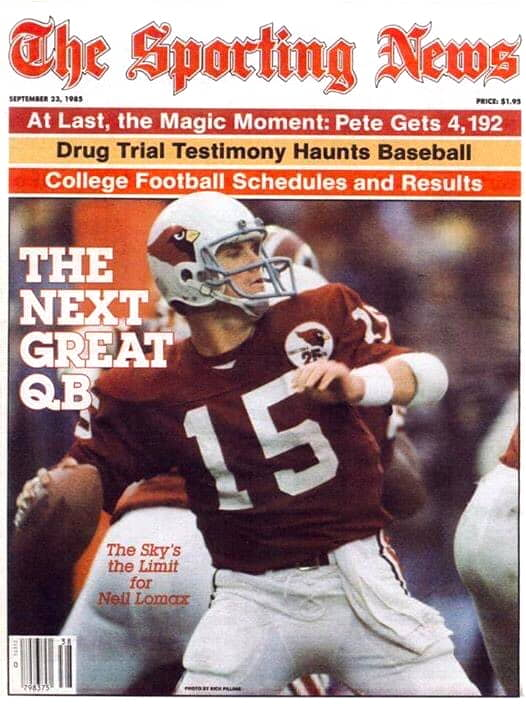
But a new star is rising. He began his ascent gradually, then shot into the constellation last year.
That star is the St. Louis Cardinals’ Neil Lomax, the latest in the NFL’s lineage of passing princes.
Lomax clearly exhibited credentials last season, throwing for 28 touchdowns and 4,614 yards and compiling the NFL’s fourth-best passer rating (92.5). He was fifth in completion percentage (.616) and sixth in yards per attempt (8.24).
Montana and Marino wound up as the leading men in Super Bowl XIX and, afterward, a Pepsi commercial. Lomax then adjourned to less-than-cosmopolitan West Linn, Oregon, where he spent a predominantly quiet off-season clutching golf clubs and fishing rods.
And there’s the disparity. Montana and Marino have become celebrities off the field. Lomax’s star? After the season, it sets rather inconspicuously in the Pacific Northwest.
“No, Pepsi did not call me to do the commercial with Joe Montana,” said Lomax smiling. “I don’t see myself in the shadows and footsteps of those guys at all when it comes to that. “I don’t remember who it was, but someone once said to me: ‘Neil Lomax, you’re the most unpublicized quarterback in the league.’ That kind of stuck in the back of my mind. It’s kind of nice in a way.”
“I just don’t feel like traveling to New York or Los Angeles or Chicago to do little promotional deals for whoever it might be. I just don’t get into the patting on the back and the ranting and raving that publicity gets into.”
Lomax isn’t exactly a stranger to the mass media. He has done endorsements in St. Louis for a jeweler and an automobile dealership. And he spent a lot of the past offseason in Oregon working as a consultant for Nike shoes.
Other companies have left the calling cards. But Lomax has more precious values. His personal life revolves around his family and, now, his wife, the former Laurie Exley. They met several years ago in Portland and were married last February.
“Our marriage was a very new thing to me,” he said. “We really worked on that and spent a lot of time together. She’s my best friend. I think that’s very important to take the first year and really get to know each other even more.”
Lomax doesn’t necessarily scorn the commercial spotlight. For example, he could envision himself as a part of Pepsi’s new generation.
“If I was approached by Pepsi and given $50,000 to do that commercial, I think I might take that,” he said. “Wouldn’t you? But I’ll cross that bridge when I come to it.”
Unlike Marino, Lomax’s rise has not been meteoric. His development as an NFL quarterback can be traced through several distinguishable stages.
Stage 1 — In the beginning. A frustrated Jim Hanifan sat in his office on a November night in 1981. A day earlier, his Cardinals had been pulverized 52-10 by the Philadelphia Eagles and, with a 3-7 record, seemingly were headed down a dead end. As he looked at his roster, Hanifan decided a change was in order.
“We had a young football team, and here was a young quarterback,” said Hanifan. “We might as well all grow together.”
With six weeks left in his rookie season, Lomax was named to replace 15-year veteran Jim Hart. It was a controversial announcement that divided the players’ loyalty at first. But it wasn’t long before Lomax began attracting votes of confidence from both sides.
With Lomax at quarterback, the Cardinals embarked on a four-game winning streak. The zenith for Lomax came in the third game of that streak when he engineered a touchdown drive in the final two minutes for a 27-20 victory over New England. He and wide receiver Roy Green collaborated on a 33-yard pass for the winning touchdown.
“I think that was a good omen of things to come,” Lomax said.
The magic disappeared in the final two games, however. New York Giants linebacker Lawrence Taylor left Lomax feeling “discombobulated,” and the Eagles whipped St. Louis in the season finale. But Lomax’s foundation had been cemented.
Stage II — Growing pains. The 1982 season, with its 57-day player’s strike, was an annoying interruption in Lomax’s progress. After the strike, the Cardinals employed a conservative – almost cautious – offense. They finished last in the NFC East in passing yardage, and Lomax attempted fewer passes (205) than any other quarterback.
But it was not a lost season for Lomax, who had a streak of 100 consecutive passes without an interception. He orchestrated a last-second touchdown drive against the Giants that clinched a playoff berth for the Cardinals. In a 41-16 loss to Green Bay, he passed for 385 yards – the most ever by an NFL quarterback in his first playoff game.
Stage III – A time for cultivation. After the ’82 season, Hanifan hired Rod Dowhower away from the Denver Broncos to replace offensive coordinator Harry Gilmer who had moved into the scouting department.
A strict technician, Dowhower overhauled Lomax’s mechanics, tuning them piece by piece. Imperfections were remedied or eliminated.
“He became a refined quarterback,” said Hanifan. “He really improved in setting up, reading coverages, and making decisions about who to go to.”
It was Lomax’s performance in a ’83 preseason game against the Bears that particularly intrigued Hanifan, who recalled how anxious he was to get back to training camp and see it again on film.
“I remember looking at the film and being so happy,” said Hanifan. “What I saw was refinement coming through in his drops, his footwork, setting up – all those factors. I thought, ‘Holy catfish! He has arrived.’”
Stage IV – Breaking out. Only two other quarterbacks have passed for more yards in one season than Lomax did in 1984. Marino threw for 5,084 yards last year. San Diego’s Dan Fouts produced 4,802 in 1981 and 4,715 in 1980.
The change in the Cardinals passing offense was almost metamorphic. From ranking 13th in the NFC in 1983, it soared to third in the league last in 1984.
“That was a staggering step we took,” Lomax said. I didn’t really think we could be that good that quick.”
“I remember the year before, Rod really stressing the fact we needed to throw the ball a lot more for a better percentage, more yards, and more touchdowns to lead the league, or at least emphasize the Cardinals are a good offense.”
“I think any quarterback halfway decent would do fairly well with guys like Roy Green and Pat Tilley. And, obviously, I know the most important part is the offensive line. We had a good offensive line last year (1984). They’re really coming into their own.”
Neil Lomax
Since O.J. Anderson’s arrival in 1979, the Cardinals have had an effective running game. They now possess one of the most potent offenses. Just look around the league and check the creases on the foreheads of defensive coordinators.
The precise routes run by Pat Tilley wear down defenses, setting them up for the knockout punchy. The Lomas-to-Green connection is a big-play detonator that can blow up in the faces of the best defensive bacs. They have combined for 12 touchdowns in each of the past two seasons.
“As Roy has emerged, I’ve emerged,” said Lomax. “It kind of went hand in hand.”
Lately, Green’s hands have been the most magnetic in the league. He has caught more passes (156) in the past two seasons than any other receiver and his 1.555 yards receiving in ’84 was the third-highest total ever. He averaged a staggering 45.1 yards on his scoring plays last year and had touchdown receptions of 45, 47, 53, 56, 70, 75, and 83 yards.
“I don’t know what else needs to be said about him,” Lomax said. “I think he’s the best receiver in the business. I wouldn’t want to cover him. If I had 4.4 speed, I still wouldn’t want to cover him. Roy has that deep threat that has every defensive back and safety worried.”
“I think any quarterback halfway decent would do fairly well with guys like Roy Green and Pat Tilley. And, obviously, I know the most important part is the offensive line. We had a good offensive line last year. They’re really coming into their own.”

Lomax’s “protection agency,” as he calls the line, received a jolt last spring, when Luis Sharpe jumped to the United States Football League, leaving a gaping hole at left tackle. Then, left guard Terry Stieve announced his retirement early in training camp.
But second-year lineman Doug Dawson inherited Stieve’s job and already looks like a seasoned veteran. And Sharpe recently re-signed with the Cardinals. The protection agency appears secure again.
Even in Lomax’s rookie mini-camp, Hanifan saw the potential for greatness Lomax’s arm was strong, his feet were mobile, and his eyes assimilated the picture from sideline to sideline.
But there is an extra dimension to Lomax, an ingredient not all quarterbacks develop.
“The thing that stood out in my mind was his field vision,” Hanifan said. “He saw things other people don’t see.”
It’s more than just an ability to dissect defenses and read his receivers. For some reason, Lomax has a sixth sense when it comes to avoiding 300-pound behemoths trying to leave tire prints on his body.
Former Giants defense end Casey Merrill said, “He has survival intelligence. You get good heat on him and he scrambles and buys time.”
Lomax, who admits his vision is terrible without his contact lenses, finds it hard to explain himself.
It’s definitely a God-given talent,” he said. “It’s a feel. I watch the films and I can’t explain how I can feel someone coming from my backside, ready to just cream me, and I can dump it off or throw it away.”
Whatever, he had it back at Portland State University, where as engineer of Coach Mouse Davis’ run-and-shoot offense, Lomax was one of the most prolific passers in the history of college football.
He passed for 13,220 yards, establishing 90 NCAA Division I-AA records and eight all-division marks. He once tossed seven touchdown passes in one quarter. As a senior, Lomax completed 296 of 473 passes for 4,094 yards and 37 touchdowns with only 12 interceptions.
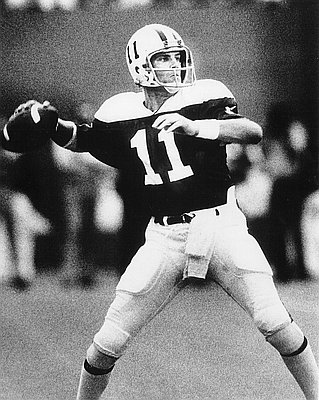
“The kid was virtually impossible to stop his senior year,” said Davis, who now coaches the Denver Gold of the United States Football League. “He had remarkable statistics and remarkable poise.”
Davis used to showcase Lomax when NFL scouts would drop by practice. One afternoon Gil Brandt, vice president of personnel development for the Dallas Cowboys, was in the audience. After watching Lomax demonstrate the spectrum of the passing game, Brandt said, “Geez, the system isn’t just the whole thing with him.”
“Obviously, the knock on him was the level of competition,” Davis said. “But at the same time, if you looked at what the young man could do, you had to believe he was a sure thing. If he couldn’t make it in the NFL, then that league was tougher than I thought.”
Several teams inspected Lomax closely before the 1981 draft. Among them were the Cowboys, who invited him down for a tryout and barbecue at Texas Stadium, and the Green Bay Packers who decided Lomax would not be a durable commodity in the NFL.
Lomax has a pronated ankle condition. His ankles point inward, and his feet are flat. “It’s clear to anyone who walks into the locker room and sees me with my socks off,” he said. “But I’m not some deformed animal.”
A Packers doctor concluded Lomax’s feet didn’t have proper support and couldn’t stand up to the pounding for more than three or four years. Lomax failed the Packers physical.
After making linebacker E.J. Junior their No. 1 choice, the Cardinals wound up selecting Lomax with the fifth pick in the second round of the draft. Hanifan said it was “like having two first-round picks.”
Only one other quarterback, Rich Campbell, was selected ahead of Lomax. He went to the Packers in the first round. After four undistinguished seasons in Green Bay, Campbell was traded to the Los Angeles Raiders, who cut him.
Campbell is now studying for the ministry at a seminary located in Portland.
When he isn’t fishing for salmon or trying to put a string of pars together during the off-season, Lomax devotes much of his time to working with youth. He addresses Fellowship of Christian Athletes groups and puts on football camps in the Portland area. He delivers a poignant message, one kids usually are surprised to hear from someone who prospered in professional sports.
“What I see in the NFL and what they see in the NFL are two completely different things,” he said. “They see success; they see happiness. If you get into the NFL or professional baseball, that’s it. You’re at the apex, the peak of life.”
“It’s always a shock to them that the average length of an NFL career is 4 and a half years. They think everybody plays for 14, 15 years like a Roger Staubach or O.J. Simpson, then gets a tryout with the ABC Monday night TV crew. That’s what they think. Everybody gets a million dollars a year, we never get taxed and we never have any problems. The girls love you. Everybody gives you free TVs and houses and everything you want. That’s just the way it’s illuminated through our society.”
“I feel bad sometimes to shatter their dreams, that it’s not that way. This is a struggling job, it’s a hard business, and what you see on TV is not exactly what takes place on Monday through Saturday.”
“The kids are grown up enough to know that, too, but they just want to see the cars and the women and the fast lane. It’s not a mission from God or something like that. I just feel like it’s one of my duties as a person, as a Christian, to say, ‘Hey, we’re human beings, you know. We make mistakes.’”
“They understand that. After a while, they see me, and we interact, and it’s ‘That’s Neil out there.’ It’s not some big hero, glamour, and glitter star, that they are seeing. That’s mostly the way it is with the kids back home and here (St. Louis), when I go to the high schools, they’re starting to get to know that, too.”
Lomax is more likely to be seen talking to youngsters than starring in a TV commercial because he chooses that scenario. Besides, that’s the way it is when you’re underpublicized.
But there’s no mistaking Lomax’s residence in the NFL. He’s in the same galaxy as those Pepsi generation quarterbacks.

 THE BIG RED ZONE
Even though Neil Lomax still ended up having a decent career, you can’t help but wonder how much better it could have been if not for the dysfunctional ways of the Big Red ownership and management. As well as the bad blood that existed between Mr.Bidwell and the Missouri politicians which eventually caused us to lose our beloved football team.
LikeLike